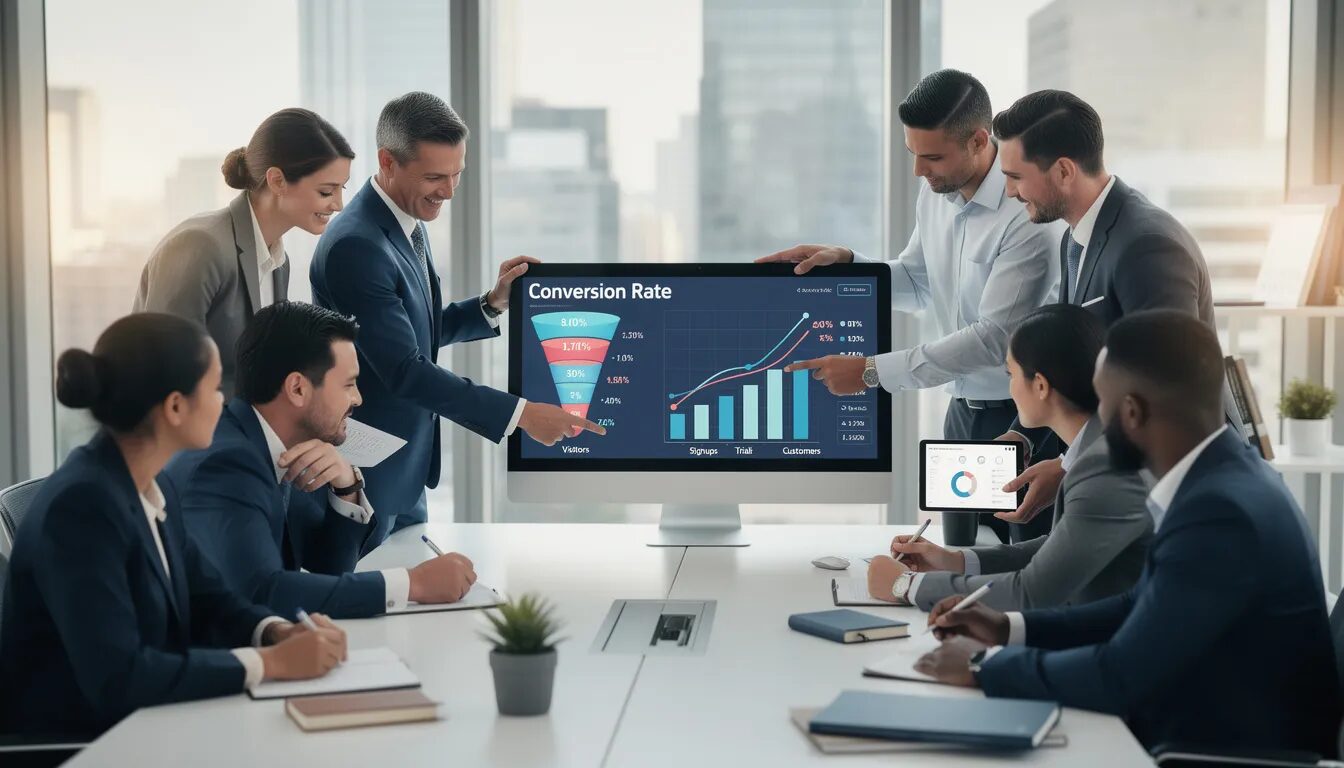
While most businesses struggle with 2-3% conversion rates, top-performing companies achieve 20-30% by mastering the art of creating high conversion sales funnels. The difference isn’t luck or magic—it’s systematic optimization of every touchpoint in the customer journey.
A high converting sales funnel transforms how potential customers interact with your business, turning casual visitors into paying customers through strategic design and psychological triggers. This comprehensive guide reveals the exact frameworks, tools, and tactics used by industry leaders to dramatically improve their conversion rates and build sustainable revenue growth. The customer journey encompasses the entire experience a customer has with a brand, from awareness to loyalty, making it essential to optimize every stage for maximum impact.
Whether you’re launching your first funnel or optimizing existing marketing efforts, you’ll discover proven strategies that significantly impact conversion rates and turn leads into loyal customers. From mapping the customer journey to implementing advanced personalization techniques, we’ll cover everything you need to build funnels that consistently deliver results.
What Makes a Sales Funnel High-Converting
A high converting sales funnel operates as a systematic approach that converts 15% or more of leads into customers, compared to the industry average of 2-3%. A funnel based approach leverages data-driven optimization and conditional workflows tailored to customer behavior and purchase conditions, ensuring each step of the funnel adapts to how prospects interact with your brand. Companies like ClickFunnels and HubSpot consistently achieve 20-30% conversion rates through strategic funnel design that addresses every stage of the buying journey. Mailchimp’s pricing page serves as a focused sales funnel that compares plans with clear, benefit-driven copy, demonstrating how clarity and focus can drive conversions. Reducing friction in the sales funnel involves simplifying processes, improving site speed, and ensuring a seamless cross-channel experience, which are critical for maintaining high conversion rates.
The foundation of any successful funnel lies in understanding your target audience deeply and creating experiences that guide them naturally toward a purchase decision. High converting funnels don’t rely on aggressive sales tactics or manipulation—they provide immediate value while addressing specific pain points at each funnel stage.
Here are the 5 critical elements that separate high-performing funnels from average ones:
• Targeted Traffic Generation: Attracting qualified prospects through channels where your ideal customers actively search for solutions • Compelling Value Propositions: Clear, benefit-focused messaging that resonates with your unique selling proposition • Optimized Landing Pages: Mobile-responsive pages with focused CTAs that guide visitors navigate toward conversion. High-converting landing pages must have a single, clear purpose and a compelling call-to-action (CTA) to drive results. • Automated Nurture Sequences: Email workflows that nurture relationships and provide value before asking for the sale • Friction Removal: Streamlined processes that eliminate barriers and reduce drop offs at critical conversion points
Key Conversion Metrics to Track:
- Lead capture rate: 25-40% (varies by traffic source)
- Email open rates: 25-35%
- Click through rates: 3-8%
- Sales conversion rate: 15-25%
- Average order value growth: 10-30% through upsells
These benchmarks provide a framework for measuring funnel performance and identifying optimization opportunities. Companies implementing systematic funnel analysis typically see 20-50% improvements in overall conversion rates within 90 days of optimization.
The 4 Essential Stages of High-Converting Sales Funnels
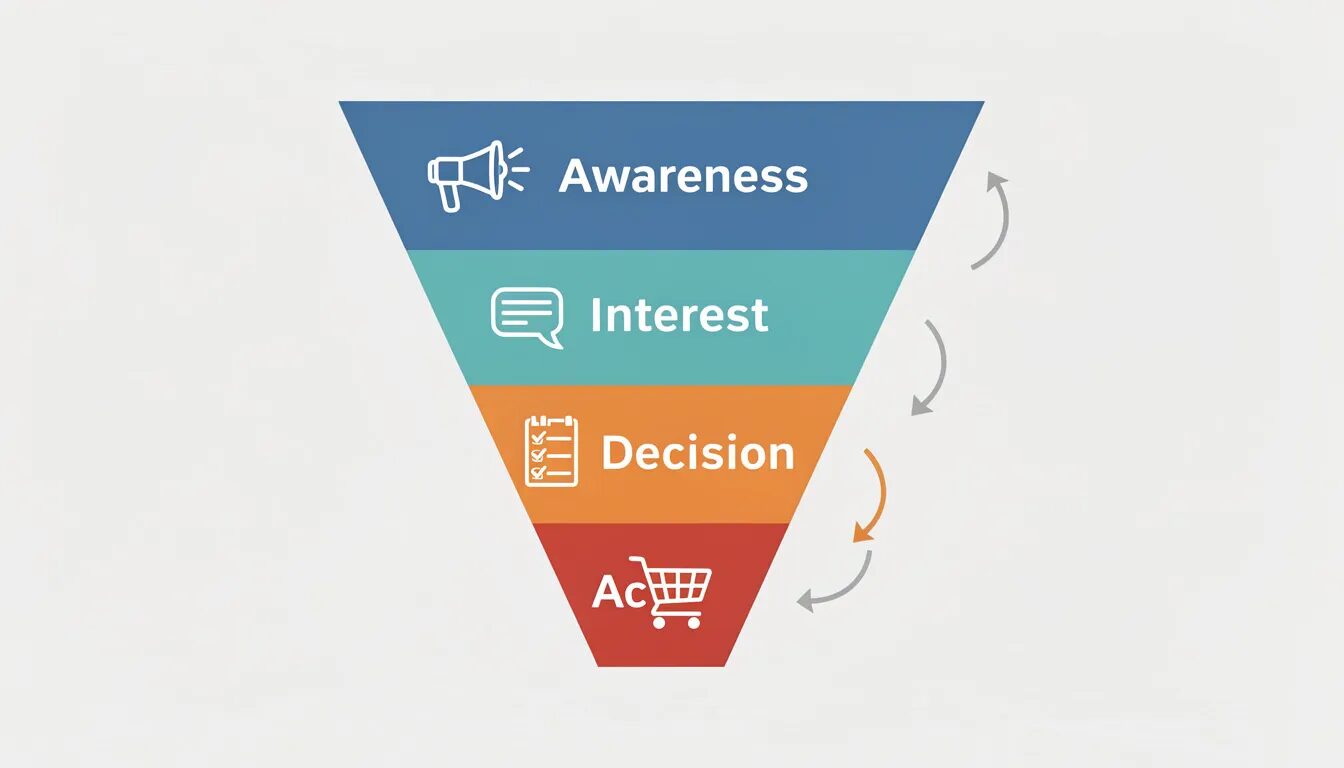
Understanding the sales funnel stages helps you create targeted content and experiences that move prospects predictably through the buying journey. The AIDA framework—Awareness, Interest, Desire, Action—provides a proven structure for creating funnels that convert.
Each stage serves a specific purpose in the customer journey, with distinct conversion benchmarks and content requirements. Successful brands like Mailchimp and Shopify excel by optimizing each stage independently while maintaining a cohesive overall experience. At every stage, providing FAQs, insightful articles, or interactive tools to answer questions helps build trust and address potential concerns, moving prospects forward in the funnel.
Stage-by-Stage Conversion Benchmarks:
- Awareness to Interest: 3-5% (blog readers to email subscribers)
- Interest to Desire: 15-20% (email subscribers to demo requests)
- Desire to Action: 25-35% (qualified leads to paying customers)
- Post-Purchase Retention: 60-80% (first-time to repeat customers)
Stage-Specific KPIs to Monitor:
| Funnel Stage | Primary KPI | Target Range | Content Focus |
|---|---|---|---|
| Awareness | Website Traffic | 1000+ monthly visitors | Educational content |
| Interest | Lead Capture Rate | 25-40% | Lead magnets |
| Desire | Email Engagement | 25%+ open rate | Case studies, demos |
| Action | Sales Conversion | 15-25% | Sales pages, trials |
This systematic approach to funnel stages ensures you’re measuring what matters most at each point in the conversion funnel, enabling data driven decisions that optimize performance across the entire marketing strategy.
Top of the Funnel (TOFU): Attracting Quality Prospects
The key to successful TOFU optimization lies in understanding user behavior patterns and creating compelling content that naturally leads to the next stage. Track metrics like time on page, bounce rate, and content consumption to identify which topics and formats resonate most with your audience.
Additionally, analyzing traffic flows at the TOFU stage is essential for understanding how visitors move through your website and the conversion funnel. By optimizing these traffic flows, you can improve conversion rates and uncover hidden opportunities for engagement.
Middle of the Funnel (MOFU): Nurturing and Qualifying Leads
The middle of the funnel transforms interested prospects into qualified leads through strategic nurturing and relationship building. This stage focuses on providing deeper value while gradually introducing your solution as the best path forward.
Lead magnets serve as the primary conversion mechanism, offering valuable free resources in exchange for contact information. High-performing lead magnets achieve 40%+ opt-in rates by solving immediate, specific problems for your target audience. Offering a valuable lead magnet in exchange for contact information is essential for capturing leads and initiating the customer journey effectively.
Lead Magnet Formats That Convert:
• Industry-Specific Templates: Ready-to-use documents that save time and effort • Exclusive Webinars: Live or automated presentations featuring expert insights • Free Trials: Risk-free product experiences that demonstrate value • Assessment Tools: Interactive evaluations that provide personalized recommendations
Email sequences become the primary nurture mechanism, with effective campaigns achieving 25%+ open rates through personalized, value-focused messaging. The step by step process involves welcome emails, educational content delivery, social proof sharing, and gentle product introductions.
High-Converting Email Sequence Structure:
- Welcome Email (immediate): Deliver promised lead magnet and set expectations
- Value Email (day 2): Share additional free resources related to their interest
- Story Email (day 4): Customer success story showcasing transformation
- Education Email (day 7): Deep-dive content addressing common objections
- Social Proof Email (day 10): Testimonials and case studies from similar customers
Lead scoring systems track engagement levels and behavioral signals to identify sales-ready prospects. By monitoring email opens, link clicks, website behavior, and content downloads, you can prioritize follow-up efforts on leads most likely to convert.
Crazy Egg’s heatmap tool demonstration exemplifies effective MOFU strategy, converting 12% of trial users to paid plans by providing immediate value while showcasing product capabilities. Their approach combines free tools with educational content, building trust and demonstrating expertise simultaneously.
Bottom of the Funnel (BOFU): Converting Qualified Leads
The bottom of the funnel transforms qualified leads into paying customers through compelling offers and optimized conversion experiences. This stage requires precision in messaging, design, and psychology to overcome final objections and motivate action.
Sales pages achieving conversion rates above 15% follow proven psychological principles while addressing specific concerns of ready-to-buy prospects. Clear value propositions, social proof, urgency elements, and risk reversal combine to create irresistible offers.
High-Converting Sales Page Elements:
• Headlines: Benefit-focused statements that immediately communicate value • Social Proof: Customer testimonials, reviews, and success stories • Urgency Elements: Limited-time offers, countdown timers, and scarcity indicators
• Risk Reversal: Money-back guarantees, free trials, and satisfaction promises
Compelling offers go beyond basic discounts to create perceived value that exceeds the asking price. Limited-time discounts (24-48 hours), exclusive bonuses worth 2x the product price, and flexible payment plans reduce purchase friction while increasing average order value. Trust signals, such as reviews and guarantees, are important for reducing perceived risk in the sales funnel, ensuring prospects feel confident in their decision to buy.
Trust Signals That Increase Conversions:
- Customer testimonials with photos and specific results
- Security badges and certifications prominently displayed
- Money-back guarantees with clear terms
- Industry awards and media mentions
- Client logos from recognizable companies
Building trust and credibility in a sales funnel can be supported by integrating social proof, customer reviews, and security badges. These elements reassure prospects and reduce perceived risks, making them more likely to convert.
- Customer testimonials with photos and specific results
- Security badges and certifications prominently displayed
- Money-back guarantees with clear terms
- Industry awards and media mentions
- Client logos from recognizable companies
Checkout optimization reduces cart abandonment from the industry average of 70% to under 40% through streamlined processes. Single-page checkout, multiple payment options, guest checkout capabilities, and transparent pricing eliminate common purchase barriers.
The sales process extends beyond initial purchase through strategic upsells and cross-sells. Order bumps, one-click upsells, and related product recommendations can increase average order value by 25-40% without additional traffic acquisition costs.
Step-by-Step Process to Build Your High-Converting Sales Funnel
Building a successful funnel requires systematic planning that starts with deep audience research and maps every touchpoint of the customer journey. This foundation ensures your marketing efforts align with actual customer needs and behaviors rather than assumptions.
Begin with comprehensive audience research using tools like Facebook Audience Insights, Google Analytics, and direct customer surveys. Understanding demographics, psychographics, pain points, and preferred communication channels enables precise targeting and messaging.
Essential Research Components:
• Demographics: Age, gender, location, income, occupation, education level • Psychographics: Values, attitudes, interests, lifestyle preferences • Pain Points: Specific problems and frustrations your solution addresses • Goals: Desired outcomes and success metrics from the customer perspective • Communication Preferences: Preferred channels, content formats, and messaging styles
Map the customer journey from initial problem awareness to post-purchase satisfaction over a realistic 30-90 day timeline. This mapping reveals critical touchpoints where prospects make decisions and identifies opportunities to provide value and build trust.
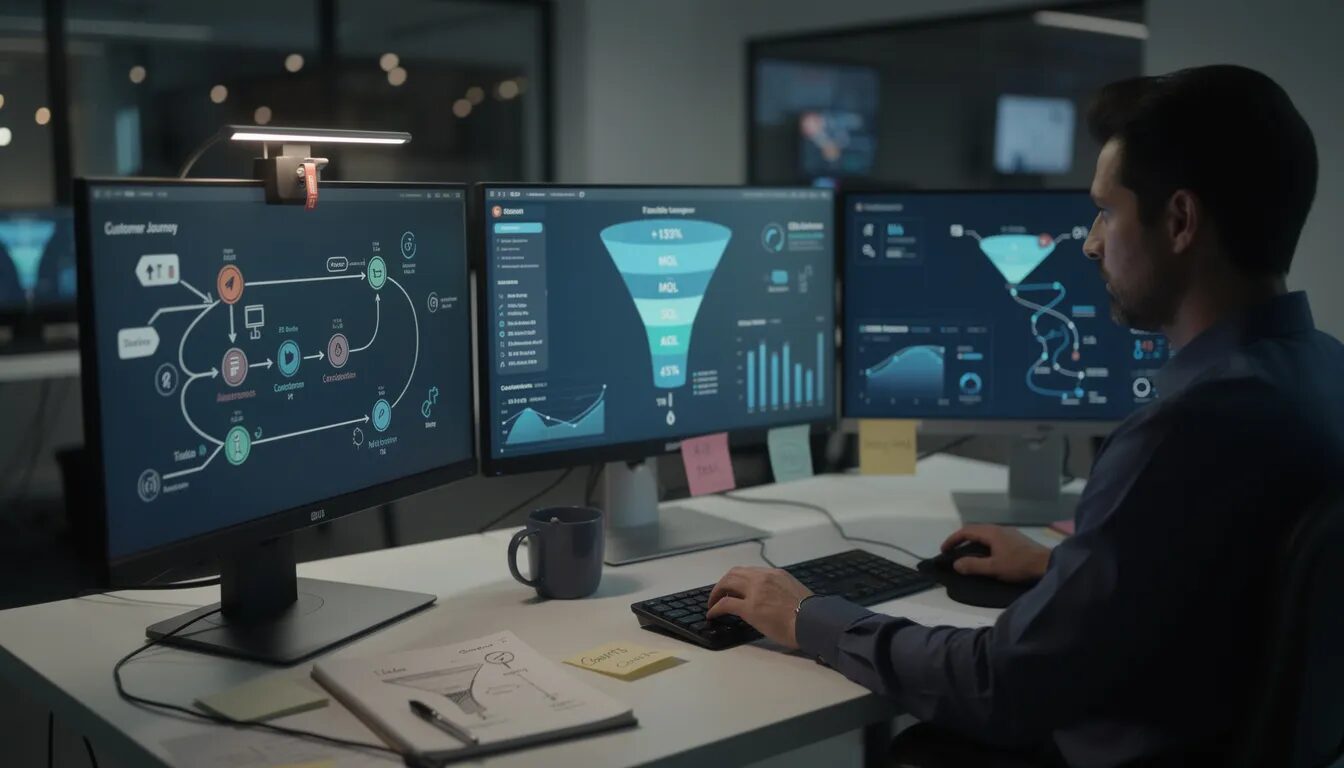
Customer Journey Mapping Framework:
| Stage | Timeframe | Customer Mindset | Key Touchpoints | Success Metrics |
|---|---|---|---|---|
| Problem Aware | Days 1-7 | “I have a problem” | Blog posts, social content | Traffic, engagement |
| Solution Aware | Days 7-14 | “I need a solution” | Lead magnets, emails | Lead capture rate |
| Evaluation | Days 14-30 | “Which option is best?” | Demos, case studies | Engagement rate |
| Purchase | Days 30-45 | “I’m ready to buy” | Sales pages, calls | Conversion rate |
| Success | Days 45-90 | “Did this work?” | Onboarding, support | Retention rate |
Create detailed customer avatars that go beyond basic demographics to include emotional triggers, objections, and decision-making criteria. These avatars guide content creation, channel selection, and messaging throughout the entire funnel journey.
Creating Irresistible Lead Magnets
Lead magnets serve as the bridge between anonymous website visitors and identified prospects, making them one of the most critical components of your conversion funnel. The most effective lead magnets solve immediate, specific problems while demonstrating your expertise and building trust.
Design lead magnets that address narrow, actionable problems rather than broad topics. “10-Minute Email Marketing Setup” converts better than a generic “Email Marketing Guide” because it promises a specific outcome in a defined timeframe.
High-Converting Lead Magnet Formats:
• PDF Guides: Comprehensive resources with step-by-step instructions and templates • Video Tutorials: Screen recordings or presentations that demonstrate processes • Templates: Ready-to-use documents, spreadsheets, or design files • Checklists: Simple, actionable lists that ensure nothing gets missed • Mini-Courses: Multi-part email series delivering concentrated learning • Free Tools: Calculators, assessments, or software that provides immediate value
Write compelling headlines using power words that create urgency and communicate clear benefits. Words like “Instant,” “Proven,” “Secret,” “Ultimate,” and “Exclusive” increase perceived value when combined with specific benefit statements.
5 Real Examples of High-Converting Lead Magnets:
- HubSpot’s Marketing Kit – 15 free tools achieving 35% conversion rate
- Neil Patel’s SEO Analyzer – Free website audit tool with 28% opt-in rate
- ConvertKit’s Email Sequence Templates – 22 proven templates converting at 31%
- Crazy Egg’s Heat Map Report – Free website analysis achieving 19% conversion
- Leadpages’ Landing Page Templates – Design templates with 42% opt-in rate
Test different lead magnet formats to discover what resonates most with your target audience. Some audiences prefer video content, while others respond better to downloadable resource materials. Track not only opt-in rates but also engagement with the delivered content.
The downloadable resource strategy works particularly well for B2B audiences who prefer comprehensive materials they can reference repeatedly. Ensure your lead magnets align with your eventual product offering to attract qualified prospects rather than just information seekers.
Building High-Converting Landing Pages
Landing pages serve as the conversion hub of your sales funnel, where visitors decide whether to take the next step in their journey. High-converting pages follow proven structural principles while delivering compelling value propositions that address visitor motivations.
Follow the proven landing page structure that guides attention and builds momentum toward conversion: attention-grabbing headline, benefit-focused subheadline, supporting hero image or video, bullet-pointed benefits, and prominent call-to-action button.
Conversion-Focused Copy Framework:
• Headline: Primary benefit or outcome in 10 words or fewer • Subheadline: Elaboration on the headline with additional context • Body Copy: Specific benefits addressing the “What’s in it for me?” question • Social Proof: Testimonials, reviews, or usage statistics • CTA: Action-oriented language that creates urgency
Write copy that addresses the visitor’s primary question within 5 seconds of page load. Research shows that users form impressions of web pages within 50 milliseconds, making immediate clarity essential for maintaining attention and preventing bounce.
Design mobile-first pages that load under 3 seconds with prominent CTAs visible without scrolling. With over 60% of web traffic coming from mobile devices, responsive design isn’t optional—it’s essential for maintaining high conversion rates across all devices.
A/B Testing Checklist for Landing Pages:
- Headlines: Test benefit-focused vs. curiosity-driven approaches
- CTAs: Compare action words, colors, sizes, and placement
- Images: Test hero shots vs. product screenshots vs. customer photos
- Form Fields: Experiment with required fields and progressive profiling
- Social Proof: Compare testimonials, reviews, logos, and statistics
- Page Length: Test long-form vs. short-form based on complexity
Track user behavior using heatmap tools to identify where visitors click, scroll, and abandon. This data reveals optimization opportunities that aren’t obvious from conversion rate data alone, such as confusing navigation or overlooked content sections.
All the tools for landing page optimization should work together to create a seamless experience that feels natural and trustworthy. Remove distracting elements, simplify navigation, and ensure every page element supports the primary conversion goal.
Designing Automated Follow-Up Sequences
Email automation transforms one-time visitors into long-term customers through systematic relationship building and value delivery. Well-designed sequences nurture leads over time while qualifying prospects and addressing common objections before they arise. Automated follow-ups are important for maintaining engagement with leads throughout the sales funnel, ensuring that no opportunity is missed to guide them toward conversion.
Create a foundational 7-email nurture sequence that delivers value while gradually introducing your solution: welcome email (immediate), value delivery (day 2), case study (day 4), social proof (day 7), objection handling (day 10), urgency creation (day 14), and final offer (day 21).
High-Converting Email Sequence Structure:
- Welcome Email – Immediate delivery of promised lead magnet plus expectation setting
- Value Email – Additional free resource related to their specific interest
- Case Study Email – Customer transformation story relevant to their situation
- Social Proof Email – Testimonials and success metrics from similar customers
- Objection Handling Email – Address common concerns with evidence and reassurance
- Urgency Email – Limited-time offer or bonus to encourage action
- Final Offer Email – Last chance messaging with clear next steps
Personalize emails using behavioral triggers and segmentation based on lead source, interests, and engagement patterns. Subscribers who download pricing guides receive different messaging than those who access educational content, ensuring relevance and improving conversion rates.
Email Templates with High-Performing Subject Lines:
- Welcome: “Your [Lead Magnet] is ready + what’s next” (42% open rate)
- Value: “One more thing to help you [achieve goal]” (38% open rate)
- Case Study: “How [Similar Customer] achieved [specific result]” (35% open rate)
- Social Proof: “Join 10,000+ customers getting [benefit]” (33% open rate)
Set up marketing automation workflows using platforms like ConvertKit, ActiveCampaign, or HubSpot to trigger different email sequences based on specific actions. Visitors who attend webinars receive different follow-up than those who download whitepapers.
Track email performance metrics beyond open and click rates to understand true engagement. Monitor unsubscribe rates, reply rates, and conversion to next funnel stage to identify which messages resonate and which need optimization.
The key to successful email nurturing lies in providing consistent value while gradually building trust and demonstrating expertise. Avoid overly promotional messages in favor of educational content that positions your solution as a natural next step.
Advanced Funnel Optimization Techniques
Advanced optimization goes beyond basic A/B testing to implement systematic improvement protocols that consistently increase conversion rates by 15-30% quarterly. This requires sophisticated tracking, behavioral analysis, and psychological understanding of customer decision-making processes.
Implement conversion rate optimization testing protocols that prioritize high-impact changes over cosmetic adjustments. Focus on elements that directly influence purchase decisions: headlines, value propositions, pricing presentation, social proof, and call-to-action design.
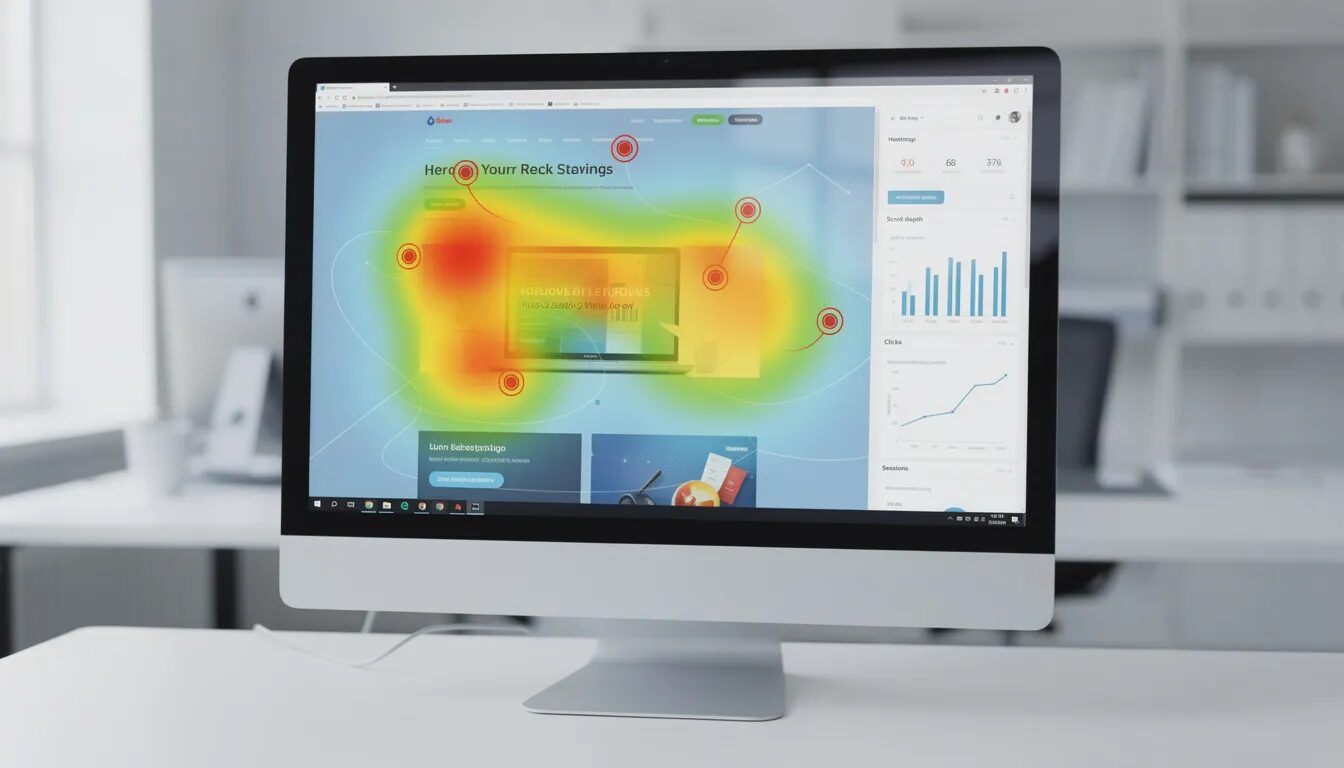
Use heat mapping and session recording tools like Hotjar to identify friction points and understand user behavior patterns that aren’t visible in traditional analytics. Watch actual user sessions to discover where prospects hesitate, abandon, or get confused during the conversion process.
Psychological Triggers That Drive Conversions:
• Scarcity: Limited quantities or time-sensitive offers create urgency • Social Proof: Customer testimonials and usage statistics build trust • Authority: Expert endorsements and certifications establish credibility • Reciprocity: Free value creates psychological obligation to reciprocate
Apply these triggers ethically by highlighting genuine limitations and authentic customer experiences. False scarcity and fabricated testimonials damage long-term brand trust and can lead to legal issues in many jurisdictions.
Data-Driven Optimization Methodology:
- Baseline Measurement: Establish current performance across all key metrics
- Hypothesis Formation: Identify specific improvements based on user behavior data
- Test Design: Create variations that isolate single variables for clear attribution
- Implementation: Run tests with proper statistical significance requirements
- Analysis: Evaluate results and implement winning variations
- Documentation: Record learnings for future optimization cycles
This systematic approach ensures optimization efforts compound over time rather than creating random fluctuations in performance. Track metrics and maintain detailed records of all tests, results, and implementation decisions.
A/B Testing for Maximum Conversions
A/B testing reveals which elements of your funnel generate the biggest impact on conversion rates, but only when executed with proper methodology and statistical rigor. Focus on testing high-impact elements first to maximize the return on your optimization efforts.
Test elements with the highest potential for improvement: headlines can improve conversions by up to 40%, CTAs by up to 25%, and pricing presentation by up to 20%. These represent the biggest opportunities for meaningful improvement.
Testing Priority Framework:
• Headlines: Primary value proposition and benefit statements • Call-to-Actions: Button text, color, size, and placement • Social Proof: Testimonial selection, placement, and format • Pricing: Display format, anchoring, and plan comparison • Forms: Field requirements, layout, and progressive profiling • Images: Hero shots, product photos, and customer visuals
Follow statistical significance requirements to ensure test results are reliable: minimum 100 conversions per variation, 95% confidence level, and test duration of 2-4 weeks. Stopping tests early or with insufficient data leads to false conclusions and poor optimization decisions.
Monthly Testing Calendar:
- Week 1: Headlines and value proposition tests
- Week 2: CTA button optimization (text, color, placement)
- Week 3: Social proof variations (testimonials, reviews, stats)
- Week 4: Pricing and offer presentation tests
Document all testing activities in a centralized repository that tracks date, hypothesis, methodology, results, and implementation decisions. This creates institutional knowledge that prevents repeating failed tests and builds on successful optimizations.
B testing should focus on meaningful variations rather than minor cosmetic changes. Test dramatically different approaches to headlines, offers, and page layouts to discover breakthrough improvements rather than incremental gains.
Monitor secondary metrics alongside primary conversion goals to understand the full impact of changes. A headline that increases email signups but decreases sales-qualified leads may not represent true improvement.
Personalization and Segmentation Strategies
Personalization transforms generic funnel experiences into tailored journeys that speak directly to individual prospect needs and preferences. Advanced segmentation strategies can increase conversion rates by 20-50% by delivering relevant content at optimal times. A tripwire sales funnel offers something valuable at a low cost to encourage prospects to make a small purchase, creating an entry point for further engagement and upselling opportunities.
Segment audiences by traffic source to deliver appropriate messaging: organic search visitors receive educational content, paid ad traffic sees direct offers, social media visitors get community-focused messaging, and referrals receive testimonial-heavy pages.
Behavioral Segmentation Triggers:
• First-Time Visitors: Lead magnets and educational content • Returning Visitors: Product demos and comparison content • High-Engagement Users: Direct sales offers and consultations • Cart Abandoners: Retargeting with incentives and urgency
Create dynamic content that automatically adjusts based on visitor behavior and characteristics. Show different offers, testimonials, and calls-to-action based on past interactions, demographic data, and engagement level. As a personalization tactic, a tripwire funnel can be used to present new leads with a low-cost, high-value product immediately after they opt in for a free resource, helping to segment and qualify them for further offers.
Progressive Profiling Strategy:
Rather than overwhelming prospects with lengthy forms, collect additional information over time through progressive profiling. Start with basic contact information, then gradually gather preferences, company details, and specific needs through subsequent interactions.
This approach reduces initial friction while enabling increasingly personalized experiences. Each additional data point allows for more targeted messaging and better lead scoring accuracy.
Implementation Tools and Tactics:
- Exit-Intent Popups: Trigger when users show abandonment signals
- Time-Based Offers: Display different content based on page duration
- Scroll-Based Reveals: Progressive content disclosure based on engagement
- Retargeting Campaigns: Follow up with specific messaging based on pages visited
Track personalization performance through cohort analysis that compares conversion rates across different segments and personalization strategies. This reveals which approaches generate the highest ROI and deserve additional investment.
Use marketing automation platforms to orchestrate complex personalization workflows that would be impossible to manage manually. These systems track behavior, update profiles, and trigger appropriate content automatically.
Proven Sales Funnel Types and Real Examples
Different business models require different funnel architectures, each optimized for specific customer behaviors, price points, and decision-making processes. Understanding these variations helps you choose the right structure for your unique situation and avoid common mismatches.
10 High-Performing Funnel Types with Benchmarks:
| Funnel Type | Primary Use Case | Avg. Conversion Rate | Ideal Price Point |
|---|---|---|---|
| Lead Generation | B2B services, consulting | 15-25% | $1,000-$50,000+ |
| Webinar Sales | Education, coaching | 10-20% | $500-$5,000 |
| E-commerce Product | Physical/digital goods | 2-5% | $20-$500 |
| SaaS Free Trial | Software subscriptions | 15-30% | $50-$500/month |
| Quiz Funnel | Personalized recommendations, lead segmentation | 25-40% | $100-$2,000 |
| Product Launch Funnel | Building anticipation for new products | 5-15% | $200-$2,000 |
| Online Courses | Selling digital education and coaching | 8-18% | $200-$5,000 |
| Quiz/Assessment | Personalized solutions | 25-40% | $100-$2,000 |
| Product Launch | New product introduction | 5-15% | $200-$2,000 |
| Tripwire | Low-ticket to high-ticket | 8-15% | $7-$97 initial |
Choose funnel types based on your business model, target audience preferences, and price point. B2B services typically require longer lead generation funnels with consultative sales, while e-commerce benefits from streamlined product funnels with minimal friction.
Quiz funnels gather information about prospects through interactive quizzes, allowing you to personalize recommendations and guide users toward tailored offers, which increases engagement and conversions. Product launch funnels strategically build anticipation before a product release using teaser campaigns, opt-in pages, and email sequences to generate excitement and drive early sales. Online courses are effectively sold through webinar and education-based funnels, leveraging live or automated presentations to demonstrate value and convert leads into students.
Each funnel type requires specific optimization strategies and success metrics. Webinar funnels focus on registration and attendance rates, while e-commerce funnels prioritize cart completion and average order value.
Implementation Considerations:
• Sales Cycle Length: Complex B2B solutions need longer nurture periods • Trust Requirements: High-ticket offers require more social proof and risk reversal • Decision-Making Process: Individual vs. committee purchases affect funnel structure • Market Competition: Saturated markets need stronger differentiation strategies
Track funnel performance across different customer segments to identify which types work best for specific audiences. Some prospects respond well to educational approaches, while others prefer direct product demonstrations.
Lead Generation Funnels
Lead generation funnels excel in B2B environments and high-ticket service businesses where the sales process involves consultation and customization. These funnels prioritize relationship building and trust development over immediate transactions.
HubSpot’s Marketing Hub funnel demonstrates the power of systematic lead generation: blog traffic drives ebook downloads, which generate demo requests, ultimately achieving a 32% lead-to-customer conversion rate through multi-touch nurturing over 30-90 days.
Lead Generation Funnel Structure:
- Top of Funnel: SEO-optimized blog content attracting 100,000+ monthly visitors
- Lead Capture: Gated premium content capturing 3-5% of visitors as leads
- Nurturing: 10-email educational sequence over 30 days with case studies
- Qualification: Demo requests and consultation bookings from warmed prospects
- Sales Process: Consultative approach addressing specific business needs
The content marketing approach relies heavily on organic traffic generation through search engine optimization. Companies like HubSpot invest heavily in creating comprehensive resources that rank for thousands of keywords related to their target audience’s challenges.
Multi-Touch Nurturing Components:
• Educational Content: Industry insights, best practices, and how-to guides • Case Studies: Detailed success stories with measurable outcomes • Webinars: Live and automated sessions demonstrating expertise • Personalized Outreach: Sales development rep follow-up based on engagement • Social Proof: Customer testimonials and industry recognition
This systematic approach to collecting leads and nurturing relationships enables higher conversion rates than direct sales approaches because prospects feel educated and supported rather than pressured.
Lead Generation Funnel Implementation Guide:
- Month 1: Create foundational content and lead magnets
- Month 2: Launch email nurture sequences and scoring systems
- Month 3: Implement sales handoff processes and qualification criteria
- Ongoing: Optimize based on lead quality and conversion data
Track both quantity and quality metrics to ensure lead generation efforts produce revenue results. High lead volume with low conversion rates indicates targeting or qualification problems.
Webinar Sales Funnels
Webinar funnels combine education with sales in a format that builds authority while addressing objections in real-time. This approach works particularly well for coaching, consulting, and educational products where demonstration of expertise is crucial for conversion.
Russell Brunson’s ClickFunnels webinar strategy exemplifies this approach: registration pages achieving 40% conversion rates, webinar attendance rates of 25%, and sales presentations converting 15% of attendees through strategic content delivery and psychological triggers.
Three-Part Webinar Structure:
• Value-Packed Teaching (45 minutes): Solve a real problem with actionable strategies • Transition Story (10 minutes): Personal or customer journey that introduces the offer • Offer Presentation (30 minutes): Detailed solution with clear next steps and urgency
The teaching portion must deliver genuine value that attendees could implement independently. To maximize conversions, focus on delivering actionable tips that participants can apply immediately—this not only demonstrates your expertise but also builds trust and encourages attendees to take the next step. Avoid holding back critical information as a sales tactic.
High-Converting Webinar Registration Elements:
- Headline: Specific outcome promise with timeframe
- Bullets: Key learning points and promised revelations
- Speaker Credentials: Authority indicators and social proof
- Urgency: Limited seats or time-sensitive bonuses
- Simple Form: Name and email only to reduce friction
Follow-up sequences target both attendees and non-attendees with tailored messaging. Non-attendees receive replay access with deadline pressure, while attendees get additional bonuses and objection-handling content. Articulate Marketing promotes webinars where prospects register to watch and exchange their details for access, turning sign-ups into qualified leads, showcasing the power of webinars in nurturing and converting prospects.
Webinar Funnel Journey:
| Stage | Conversion Rate | Key Elements | Follow-up Strategy |
|---|---|---|---|
| Ad to Registration | 3-8% | Benefit-focused headlines | Confirmation sequence |
| Registration to Attendance | 20-30% | Reminder emails, value previews | Show-up sequence |
| Attendance to Purchase | 10-20% | Value delivery, offer presentation | Replay sequence |
| Follow-up Conversions | 5-10% | Urgency, bonuses, payment plans | Last chance emails |
The webinar funnel excels when your solution requires education or when trust-building is essential for conversion. It allows prospects to experience your expertise before making purchase decisions, reducing risk perception and increasing conversion likelihood.
Use interactive elements like polls, Q&A sessions, and live chat to increase engagement and create community feeling. Higher engagement correlates directly with conversion rates and customer satisfaction.
E-commerce Product Funnels
E-commerce funnels optimize every step from product discovery to post-purchase retention, focusing on reducing friction and maximizing average order value through strategic offers and streamlined experiences.
Amazon’s optimization strategies demonstrate the power of systematic e-commerce funnel design: product page optimization, one-click checkout, personalized recommendations, and automated abandoned cart recovery combine to achieve industry-leading conversion rates.
E-commerce Funnel Optimization Points:
• Product Discovery: Search optimization and category navigation • Product Pages: Images, descriptions, reviews, and related products
• Add to Cart: Clear CTAs and inventory indicators • Checkout Process: Minimal steps and multiple payment options • Post-Purchase: Order confirmations, shipping updates, and review requests
Upsell and cross-sell tactics significantly impact profitability: “frequently bought together” suggestions, volume discounts, and premium product comparisons can increase average order value by 25-40% without additional traffic costs.
Cart Optimization Strategies:
- Guest Checkout: Remove forced account creation barriers
- Multiple Payment Options: Credit cards, PayPal, Apple Pay, etc.
- Transparent Pricing: Show total costs including shipping and taxes
- Security Badges: Display trust signals prominently
- Progress Indicators: Show checkout steps and remaining actions
Post-purchase optimization extends the customer relationship beyond initial transaction: order confirmation upsells, shipping notifications with cross-sells, delivery follow-up, review requests, and loyalty program enrollment all contribute to long-term customer value. Building loyalty and advocacy involves retaining customers and turning them into brand ambassadors through excellent post-purchase service, ensuring they continue to support and promote your brand.
E-commerce Conversion Optimization Checklist:
✓ Mobile-responsive design with thumb-friendly navigation ✓ High-quality product images with zoom and multiple angles
✓ Detailed descriptions addressing common questions and concerns ✓ Customer reviews prominently displayed with photos when possible ✓ Clear return policy and satisfaction guarantees ✓ Fast loading speeds (under 3 seconds on mobile) ✓ Streamlined checkout with minimal required fields
Track metrics beyond conversion rate to understand customer lifetime value: repeat purchase rate, average order value trends, and referral generation all indicate long-term funnel health and optimization opportunities.
The goal is transforming one-time buyers into loyal customers who generate predictable revenue through repeat purchases and referrals. Focus on the complete customer experience rather than just initial conversion.
Measuring and Analyzing Funnel Performance
Effective funnel analysis requires tracking metrics that reveal not just what’s happening, but why prospects convert or abandon at each stage. This data-driven approach enables systematic optimization that consistently improves performance over time.
Track essential metrics across four categories: traffic generation, conversion optimization, customer acquisition economics, and lifetime value. Each category provides insights into different aspects of funnel performance and optimization opportunities.
Essential Funnel Metrics Framework:
| Category | Key Metrics | Target Benchmarks | Optimization Focus |
|---|---|---|---|
| Traffic | Visitors, sources, quality scores | 1000+ monthly qualified visits | Channel optimization |
| Conversion | Stage progression rates | 15-25% overall | Experience optimization |
| Economics | CAC, ROAS, payback period | 3:1 LTV:CAC ratio | Efficiency optimization |
| Retention | Repeat rate, churn, advocacy | 60%+ repeat purchase | Value optimization |
Set up Google Analytics 4 goals and conversion tracking for each funnel stage with proper attribution modeling. This enables accurate measurement of which traffic sources and campaigns generate the highest-value customers, not just the most leads.
Attribution Modeling Considerations:
• First-Touch: Credits the initial awareness touchpoint • Last-Touch: Credits the final conversion touchpoint • Multi-Touch: Distributes credit across all touchpoints • Data-Driven: Uses machine learning to determine optimal attribution
Create weekly dashboard reporting that tracks performance trends and identifies optimization opportunities before they become significant problems. Automated alerts for metric thresholds enable rapid response to performance changes.
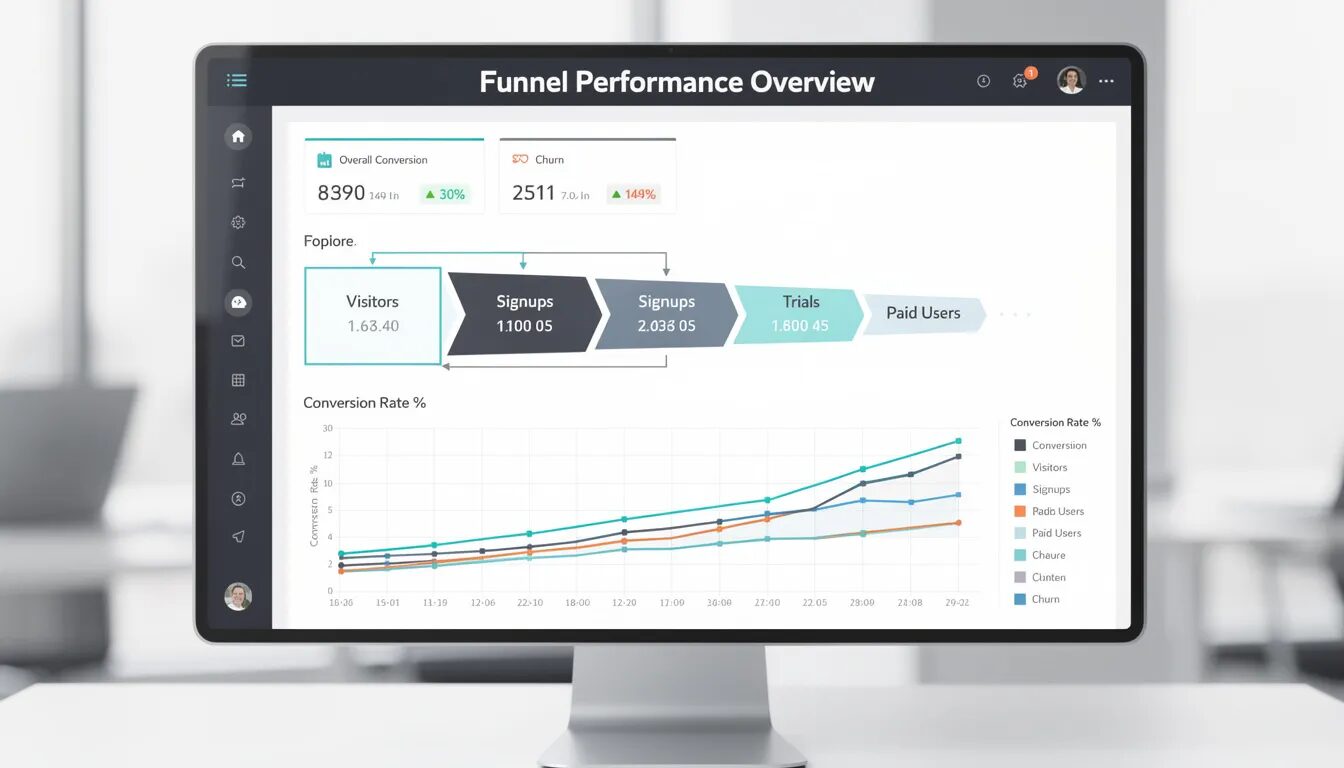
The key is connecting funnel data to business outcomes through customer lifetime value analysis. A funnel that generates lower initial conversion rates but higher-quality customers may outperform high-volume, low-retention alternatives.
Key Metrics and KPIs to Monitor
Comprehensive funnel analysis requires monitoring metrics at three levels: traffic generation, conversion optimization, and business impact. Each level provides different insights into funnel health and improvement opportunities.
Traffic Metrics and Benchmarks:
• Unique Visitors: Monthly qualified traffic volume from target segments • Traffic Sources: Organic search (40%+), paid ads (30%+), referrals (20%+), direct (10%+) • Bounce Rate: Under 40% for landing pages, under 60% for content pages • Session Duration: 2+ minutes average indicating engaged traffic quality
Conversion Metrics and Targets:
• Lead Conversion Rate: 25-40% from traffic to email subscribers • Sales Conversion Rate: 15-25% from leads to paying customers
• Email Open Rates: 25-35% indicating engaged subscriber base • Click-Through Rates: 3-8% showing compelling content and offers
Business Impact Metrics:
• Customer Acquisition Cost (CAC): Total marketing spend divided by new customers • Customer Lifetime Value (CLV): Average revenue per customer over relationship duration • Return on Ad Spend (ROAS): Revenue generated per dollar of advertising investment • Payback Period: Time to recover customer acquisition investment
Monthly Reporting Template Structure:
- Executive Summary: Key performance trends and business impact
- Traffic Analysis: Source quality, volume changes, and optimization opportunities
- Conversion Performance: Stage-by-stage progression rates and bottlenecks
- Economic Analysis: CAC trends, LTV progression, and profitability metrics
- Optimization Recommendations: Specific action items based on data analysis
Monitor leading indicators that predict future performance rather than just lagging indicators that show past results. Email engagement rates often predict sales performance 30-60 days in advance.
Track cohort performance to understand how different customer segments behave over time. Customers acquired through organic search often have higher lifetime value than paid ad customers, affecting long-term optimization strategies.
Use statistical significance testing for all performance comparisons to avoid making decisions based on random variations. Require minimum sample sizes and confidence levels before implementing changes.
Tools for Funnel Analytics and Optimization
Modern funnel optimization requires a technology stack that provides comprehensive tracking, analysis, and testing capabilities. Choose tools that integrate well together and provide the specific insights needed for your business model and optimization goals.
Analytics Platforms for Comprehensive Tracking:
• Google Analytics 4 (free): Basic funnel tracking with enhanced e-commerce and goal conversion • Mixpanel ($25/month): Advanced event tracking and user journey analysis
• Amplitude ($61/month): Sophisticated behavioral analytics and cohort analysis • Adobe Analytics (enterprise): Comprehensive platform for complex attribution modeling
Heat Mapping and User Behavior Tools:
• Hotjar ($32/month): Heatmaps, session recordings, and user feedback surveys • Crazy Egg ($24/month): Click tracking and A/B testing with visual reporting • Microsoft Clarity (free): Session recordings and heatmaps with privacy compliance • FullStory ($199/month): Complete user session capture and analysis
A/B Testing Platforms:
• Optimizely ($50/month): Enterprise-level testing with advanced targeting • VWO ($199/month): Full-stack optimization platform with personalization • Unbounce ($74/month): Landing page optimization with built-in testing • Google Optimize (discontinued): Replaced by GA4 experiments feature
All-in-One Funnel Building Platforms:
• ClickFunnels ($97/month): Complete funnel builder with templates and automation • Leadpages ($37/month): Landing page focus with conversion optimization tools • Unbounce ($74/month): Advanced landing page testing and optimization • HubSpot ($45/month): Full marketing automation with integrated analytics
Choose tools based on your tech stack requirements, team size, and optimization sophistication level. Start with free or lower-cost options and upgrade as your needs become more complex and your optimization efforts more sophisticated.
Tool Selection Criteria:
- Integration Capabilities: Works with existing marketing technology
- Ease of Use: Team can implement and maintain without extensive training
- Scalability: Grows with business needs and traffic volume
- Support Quality: Responsive help when optimization challenges arise
- Reporting Features: Provides actionable insights rather than just data
The goal is creating a measurement and optimization system that enables rapid testing and improvement cycles. Avoid tool proliferation that creates data silos and integration challenges.
Common Sales Funnel Mistakes to Avoid
Understanding common funnel failures helps you avoid costly mistakes that can reduce conversion rates by 50% or more while wasting significant marketing investment. These mistakes often stem from poor planning, inadequate testing, or misunderstanding customer psychology.
8 Critical Mistakes That Destroy Conversion Rates:
- Mismatched Traffic and Offers: Attracting visitors who don’t match your ideal customer profile
- Weak Value Propositions: Generic benefits that fail to differentiate from competitors
- Friction-Heavy Processes: Complex forms, confusing navigation, and unnecessary steps
- Poor Mobile Optimization: Ignoring 60%+ mobile traffic with desktop-only designs
- Inadequate Social Proof: Missing testimonials, reviews, and trust signals
- Unclear Calls-to-Action: Vague button text and competing conversion goals
- Broken Tracking: Missing analytics that prevent optimization and attribution
- Neglected Follow-Up: Failing to nurture leads who don’t convert immediately

Each mistake compounds others, creating downward spirals that become increasingly difficult to reverse. A weak value proposition combined with poor mobile optimization and missing social proof can reduce conversion rates to under 1%, making customer acquisition unsustainable.
Prevention Strategy Framework:
• Pre-Launch Audit: Comprehensive checklist review before traffic generation • Continuous Monitoring: Regular performance tracking and anomaly detection
• User Testing: Real customer feedback on funnel experience and messaging • Competitive Analysis: Regular comparison with industry benchmarks and best practices
Diagnostic Checklist for Existing Funnels:
✓ Message-Market Fit: Does your offer address real customer pain points? ✓ Traffic Quality: Are visitors qualified prospects or just random traffic? ✓ Mobile Experience: Does your funnel work seamlessly on smartphones? ✓ Loading Speed: Do pages load under 3 seconds on all devices? ✓ Trust Signals: Are customer testimonials and guarantees prominently displayed? ✓ CTA Clarity: Is the next step obvious and compelling? ✓ Analytics Setup: Are you tracking all critical conversion points? ✓ Follow-Up Sequences: Do you nurture non-converting prospects?
Regular funnel audits prevent small problems from becoming major conversion killers. Schedule quarterly reviews that examine performance trends, competitive landscape changes, and optimization opportunities.
Technical and Design Mistakes
Technical issues create silent conversion killers that prospects rarely report but consistently abandon. Page loading speeds over 3 seconds cause 40% visitor abandonment, while mobile-unfriendly designs lose 50%+ of smartphone traffic.
Critical Technical Issues:
• Slow Loading Pages: Every additional second reduces conversions by 7% • Mobile Responsiveness: Non-optimized pages lose mobile traffic immediately • Broken Tracking: Missing analytics prevent optimization and ROI measurement • SSL Certificate Issues: Security warnings destroy trust and credibility • Form Failures: Non-functional forms block all lead generation efforts
Complex navigation distracts from primary conversion goals by giving visitors too many choices. High-converting funnels maintain focus through simplified menus, clear page hierarchy, and single primary calls-to-action per page.
Technical Audit Checklist:
✓ Page Speed: Use Google PageSpeed Insights for comprehensive analysis ✓ Mobile Testing: Test complete funnel journey on various smartphone sizes ✓ Analytics Verification: Confirm all conversion events track properly
✓ Form Functionality: Test all forms across browsers and devices ✓ SSL Security: Ensure secure connections throughout funnel ✓ Link Integrity: Verify all internal and external links work properly
Recommended Technical Tools:
- GTmetrix: Comprehensive page speed analysis and optimization recommendations
- Google Mobile-Friendly Test: Verify mobile responsiveness and usability
- Google Tag Assistant: Confirm proper analytics and conversion tracking setup
- Screaming Frog: Technical SEO audit including broken links and errors
Address technical issues immediately as they compound over time and affect all other optimization efforts. A technically sound funnel provides the foundation for meaningful conversion rate improvements.
Monitor Core Web Vitals and user experience metrics that Google uses for search rankings. Poor technical performance affects both conversion rates and organic traffic generation over time.
Content and Messaging Mistakes
Poor messaging represents the most common cause of funnel failure, often stemming from business-centric thinking rather than customer-focused communication. Generic value propositions and feature-focused copy fail to connect with prospect motivations and desired outcomes.
Messaging Mistakes That Kill Conversions:
• Generic Value Propositions: “Best solution” or “industry leader” claims without differentiation • Feature-Focused Copy: Describing what you do rather than outcomes customers achieve • Inconsistent Messaging: Different promises across traffic sources and funnel stages • Weak CTAs: Vague action words like “learn more” instead of specific outcomes • Missing Social Proof: Absent customer testimonials and success stories
Focus on customer benefits and specific outcomes rather than product features. “Increase revenue by 30% in 90 days” converts better than “advanced analytics dashboard” because it speaks to desired results rather than technical capabilities.
Messaging Framework for High Conversions:
- Problem Recognition: Acknowledge specific pain points your prospects experience
- Solution Positioning: Present your approach as the logical solution path
- Outcome Promise: Clearly state what customers achieve with specific metrics
- Differentiation: Explain why your solution works better than alternatives
- Risk Reversal: Remove barriers with guarantees and trial periods
Before/After Messaging Examples:
Before: “Our advanced CRM platform offers comprehensive contact management” After: “Close 30% more deals with automated follow-up that never lets prospects slip through the cracks”
Before: “Learn more about our services”
After: “Get your free strategy session and see exactly how to double your leads”
Weak or unclear calls-to-action reduce conversion rates by 30% or more by creating uncertainty about next steps. Use action-oriented language that describes the specific outcome prospects will receive: “Download your free guide,” “Start your trial,” “Book your consultation.”
CTA Optimization Guidelines:
- Action Verbs: Start with specific action words like “Get,” “Start,” “Download”
- Value Clarity: Include what they receive: “Get your free analysis”
- Urgency Elements: Add time sensitivity when appropriate: “Book today”
- Benefit Focus: Emphasize outcome: “Start growing your business”
Test messaging variations systematically to discover what resonates most with your target audience. Small changes in headline or value proposition can produce 20-50% conversion rate improvements.
Scaling and Optimizing Your Sales Funnel
Scaling successful funnels requires systematic optimization processes that enable sustainable growth without sacrificing conversion quality. This involves developing repeatable testing protocols, expanding traffic sources, and implementing automation that maintains personalization at scale.
Develop a systematic optimization process that tests 2-3 elements monthly for continuous improvement. This consistent testing schedule ensures funnel performance improves steadily rather than relying on occasional breakthrough optimizations.
Monthly Optimization Schedule:
• Week 1: Traffic generation and audience targeting tests • Week 2: Landing page and lead magnet optimization • Week 3: Email sequence and nurturing improvements
• Week 4: Sales conversion and upsell optimization
Scale successful funnels through increased advertising spend, expanded target audiences, and additional traffic sources. However, scaling too quickly can overwhelm fulfillment capacity or dilute message-market fit if not managed carefully.
Scaling Readiness Checklist:
✓ Consistent Performance: 30+ days of stable conversion rates ✓ Adequate Margin: Profitable at 50% higher traffic volumes ✓ Infrastructure Capacity: Systems can handle increased load ✓ Quality Maintenance: Support and fulfillment scale with demand ✓ Attribution Clarity: Understanding of which efforts drive results
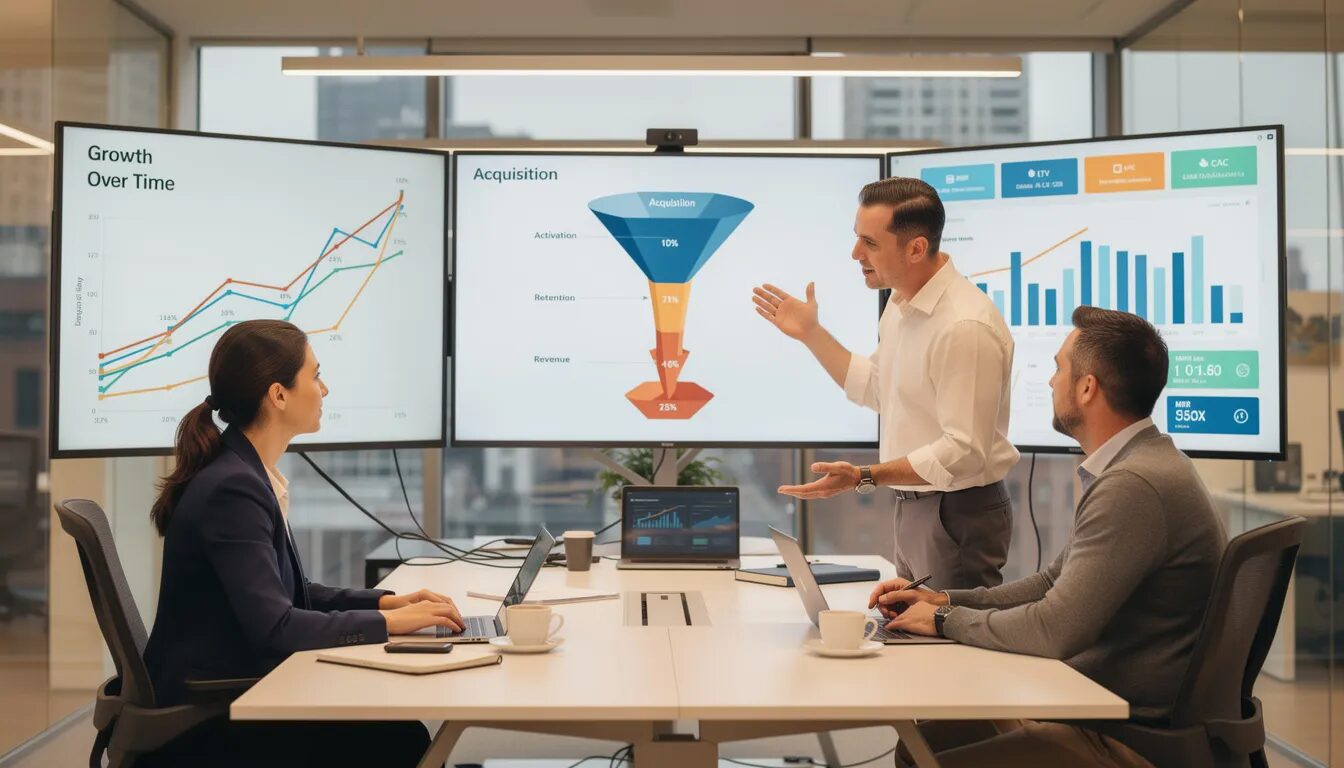
Implement advanced automation that reduces manual work while maintaining personalization through sophisticated segmentation and behavioral triggers. Marketing automation platforms enable complex workflows that would be impossible to manage manually.
Automation Opportunities for Scale:
• Lead Scoring: Automatic qualification based on engagement and behavior • Dynamic Content: Personalized messaging based on visitor characteristics • Behavioral Triggers: Email sequences activated by specific actions
• Retargeting: Automatic ad campaigns for specific prospect segments • Customer Success: Onboarding and retention workflows based on usage patterns
Create standard operating procedures for funnel management that ensure consistent optimization efforts and knowledge transfer. Document successful strategies, testing methodologies, and optimization workflows to maintain performance as teams grow.
Funnel Scaling Success Metrics:
- Revenue Per Visitor: Total funnel efficiency including upsells and retention
- Customer Acquisition Payback: Time to recover acquisition investment
- Scalability Coefficient: Performance maintenance as traffic increases
- Team Efficiency: Revenue per marketing team member over time
The goal is building a funnel system that generates predictable, scalable revenue growth while maintaining or improving key efficiency metrics. Focus on sustainable optimization rather than short-term performance spikes that can’t be maintained long-term.
Monitor leading indicators that predict scaling challenges before they impact performance: conversion rate trends, customer satisfaction scores, and operational capacity metrics all signal when scaling needs adjustment.
Transform customers into a community of advocates who drive organic growth through referrals and word-of-mouth marketing. This creates a growth flywheel effect where satisfied customers become the primary source of new prospects, reducing acquisition costs over time.
The journey from creating your first sales funnel to building a conversion optimization system represents just the beginning of sustainable business growth. High converting funnels require continuous refinement, systematic testing, and deep understanding of customer psychology to maintain peak performance.
Remember that every successful funnel starts with thorough audience research and a clear understanding of your customer journey. Use the frameworks, tools, and strategies outlined in this guide to build funnels that consistently turn leads into paying customers and loyal advocates.
The companies achieving 20-30% conversion rates didn’t get there overnight—they implemented systematic optimization processes, tracked metrics religiously, and never stopped testing new approaches. Regular analysis of the sales funnel is necessary to adapt to changing customer behaviors and market conditions, ensuring that strategies remain effective and aligned with audience needs.
Start with one funnel type that matches your business model and perfect it before expanding to additional channels or approaches. Master the fundamentals of traffic generation, conversion optimization, and customer retention before pursuing advanced tactics that can overwhelm unprepared organizations.
The opportunity to significantly impact conversion rates through strategic funnel design has never been greater. With the right approach, tools, and commitment to continuous improvement, you can transform your marketing efforts into predictable revenue generation that scales with your business growth.
Introduction to Sales Funnels
A sales funnel is a step-by-step process that guides potential customers through the buying journey, starting from the moment they become aware of your brand to the point where they make a purchase and, ideally, become loyal advocates. In today’s digital marketing landscape, a high converting sales funnel is more than just a buzzword—it’s a strategic framework that can significantly impact conversion rates and business growth. By mapping out each stage of the funnel, businesses can better understand their target audience, address specific pain points, and deliver immediate value that resonates.
The power of a well-constructed sales funnel lies in its ability to nurture leads and move them smoothly through each stage of the buying journey. This step by step process allows marketers to tailor their messaging and offers, ensuring that potential customers receive the right information at the right time. As a result, businesses can optimize their marketing strategy, increase the number of qualified leads, and ultimately drive more conversions and revenue. In a competitive digital environment, mastering the sales funnel is essential for any business looking to scale and achieve long-term success.
Understanding Your Audience
The foundation of any effective sales funnel is a deep understanding of your target audience. This means going beyond basic demographics to uncover the motivations, behaviors, and pain points that drive purchasing decisions. By conducting thorough research—such as analyzing customer data, reviewing past interactions, and segmenting your audience into detailed buyer personas—you can create marketing messages that truly resonate.
Mapping the customer journey is equally important. By visualizing how potential customers move from awareness to consideration and finally to decision, you can identify opportunities to add value, reduce friction, and address concerns at every stage. When your sales funnel is built around the real needs and challenges of your audience, you not only increase trust and credibility but also boost your chances of turning prospects into loyal customers. Keeping the customer at the center of your funnel strategy ensures that every touchpoint is optimized for engagement and conversion.
Marketing Strategy and Sales Funnels
A high converting sales funnel is only as strong as the marketing strategy behind it. Crafting a winning strategy starts with identifying your unique selling proposition and developing a content strategy that speaks directly to your target audience. By leveraging marketing funnels, you can attract traffic, nurture leads, and guide prospects through each stage of the customer journey with compelling content and offers.
Optimizing your sales funnel requires a data-driven approach. By analyzing funnel data and tracking key metrics at every stage—from the top of the funnel (TOFU) to the bottom (BOFU)—you can identify what’s working, spot bottlenecks, and make informed decisions to optimize performance. This continuous cycle of testing and refinement ensures that your marketing efforts are always aligned with audience needs and business goals. Ultimately, a well-executed marketing strategy transforms your sales funnel into a powerful engine for growth, enabling you to attract, engage, and convert your ideal customers.
Transforming Customers: From Buyers to Advocates
The journey through your sales funnel doesn’t end at the point of purchase—it’s just the beginning of building lasting customer relationships. The most successful businesses focus on transforming customers from one-time buyers into loyal advocates who champion the brand and drive organic growth. This transformation is achieved by delivering exceptional customer experiences at every stage of the funnel, from initial engagement to post-purchase support.
Advanced funnel techniques such as tripwire funnels, quiz funnels, and webinar funnels can be used to educate customers, address pain points, and build trust. The checkout page is a critical stage of the funnel, where optimizing for ease of use and reducing drop-offs can have a dramatic impact on conversion rates and revenue. By consistently exceeding expectations and nurturing relationships, you turn leads into paying customers and, ultimately, into brand advocates. This not only increases customer lifetime value but also fuels long-term business growth through referrals and repeat business.