
In today’s hypercompetitive business landscape, the ability to make rapid, accurate decisions based on relevant data has become the defining factor between industry leaders and laggards. Companies that have embraced data driven decision making are reporting unprecedented levels of operational efficiency, customer satisfaction, and revenue growth. According to 2024 research from McKinsey, 87% of organizations using comprehensive data analytics report significantly improved decision accuracy compared to their intuition-based counterparts.
The transformation from traditional gut-feeling approaches to sophisticated data driven decision making represents one of the most significant shifts in modern business strategy. This step by step guide will walk you through everything you need to know about implementing data driven decision making in your organization, from foundational concepts to advanced analytics techniques that are reshaping entire industries. The second step in the data-driven decision-making process is to collect relevant data that will help reach the decision, ensuring that the foundation for analysis is robust and aligned with organizational goals. Using accurate data is crucial for minimizing errors, reducing bias, and ensuring insightful analysis in data driven decision making. The third step involves analyzing the collected data to extract valuable insights, which form the basis for informed decision-making. The fourth step is to interpret the insights gained from the data analysis to develop strategies. DDDM is an ongoing, iterative process requiring continuous data collection and evaluation of results to ensure sustained effectiveness and adaptability.

What is Data Driven Decision Making for Modern Companies
Data driven decision making is the systematic process of making organizational choices based on quantitative analysis, customer insights, and performance metrics rather than relying solely on intuition, experience, or anecdotal evidence. For modern companies, this approach leverages cloud computing, artificial intelligence, and real-time analytics to process vast amounts of structured and unstructured data from multiple sources.
The evolution of data driven decision making has accelerated dramatically in recent years. Where companies once relied on quarterly reports and annual reviews, today’s organizations can analyze customer data, market trends, and operational metrics in real-time. Modern data analytics platforms enable business leaders to collect relevant data from diverse sources including customer interactions, supply chain sensors, social media platforms, financial systems, and financial data. Financial data, in particular, serves as a critical data source for making informed and strategic business decisions based on objective analysis.
This shift represents a fundamental change in how business decisions are made. Traditional decision making often relied on the expertise and intuition of senior executives, supplemented by limited historical data and market research. While experience and domain knowledge remain valuable, the sheer volume and complexity of today’s business environment require more sophisticated analytical methods to extract valuable insights and inform strategic choices. Data-driven decision-making enhances risk management by providing statistical evidence and predictive insights that help identify potential risks before they become problematic. However, overreliance on historical data can be problematic, as it might not accurately predict future trends, especially in rapidly changing environments, highlighting the need for adaptive and forward-looking analytics. Additionally, confirmation bias can skew data analysis, as decision-makers might selectively interpret data to support preconceived notions, underscoring the importance of objective and unbiased evaluation. Critical thinking is essential in interpreting and analyzing data, enabling organizations to draw accurate conclusions, make informed decisions, and foster a culture of inquiry that enhances data-driven outcomes.
According to recent industry studies, companies that have fully implemented data driven strategies show 23% higher profitability compared to their competitors. These organizations use advanced data analytics to optimize everything from inventory management and customer acquisition to product development and risk assessment. The key differentiator isn’t just access to data—it’s the ability to transform raw data into actionable insights that drive measurable business outcomes. For instance, a major streaming video service uses data analytics to inform aspects of its content creation and market expansion process. DDDM can lead to improved agility and speed in responding to market changes, reduced risks, enhanced customer insights, and better financial performance, making it a cornerstone of modern business success. For instance, Uber uses real-time data to optimize driver routes and manage pricing dynamically, enhancing user experience and operational efficiency.
Modern data driven decision making encompasses several critical components: comprehensive data collection from internal and external sources, robust data quality management, advanced analytical methods including machine learning algorithms, real-time data visualization, and continuous monitoring of decision outcomes. The ultimate goal of DDDM is to convert raw data into actionable insights that drive specific actions and strategies, ensuring that every step in the process contributes to measurable business value.
5 Key Benefits of Data Driven Decision Making for Modern Companies
Enhanced Operational Efficiency and Cost Reduction
Operational efficiency represents one of the most immediate and measurable benefits of implementing data driven decision making. Modern companies are using predictive analytics and real-time monitoring to optimize their business processes, reduce waste, and streamline operations across all departments.
Walmart, for example, reduced inventory costs by 15% in 2023 by implementing advanced data analytics across their supply chain operations. Their system analyzes millions of data points including customer purchasing patterns, seasonal trends, supplier performance metrics, and economic indicators to optimize inventory levels and reduce carrying costs. This approach has eliminated both stockouts and excess inventory, directly impacting their bottom line.
Energy companies have revolutionized equipment maintenance through data driven approaches. By installing IoT sensors on critical machinery, they can monitor performance metrics in real-time and predict equipment failures before they occur. This predictive maintenance strategy has reduced unplanned downtime by up to 50% while extending equipment lifespan and optimizing maintenance schedules. The result is significant cost savings and improved operational reliability.
Manufacturing companies are leveraging data analytics to identify bottlenecks in production lines, optimize resource allocation, and reduce manufacturing cycle times. Analyzing operational data is crucial for identifying inefficiencies, streamlining workflows, and reducing costs throughout the production process. Real-time analysis of operational data enables immediate adjustments to production parameters, quality control processes, and workforce deployment. Companies implementing these systems report processing time reductions from days to minutes for critical operational decisions.
The automation capabilities enabled by data driven decision making extend beyond cost reduction to fundamental process transformation. Organizations can now implement automated decision systems for routine operational choices, freeing human resources for strategic initiatives while ensuring consistent, objective decision making based on predetermined analytical criteria.
Superior Customer Experience and Personalization
Customer experience has emerged as a primary competitive differentiator, and data driven decision making enables unprecedented levels of personalization and service optimization. Companies are using customer data analytics to understand individual preferences, predict behaviors, and deliver tailored experiences across all touchpoints.
Netflix exemplifies the power of data driven customer experience optimization. Their recommendation algorithm, which analyzes viewing history, user ratings, and behavioral patterns, drives approximately 80% of content consumption on their platform. This sophisticated data analysis enables them to present personalized content recommendations that keep users engaged and reduce churn rates significantly.
Dynamic pricing strategies represent another powerful application of customer data analytics. Companies like Uber and Airbnb use real-time demand data, competitive intelligence, and customer behavior analysis to optimize pricing strategies. These algorithms consider factors including time of day, weather conditions, local events, and historical demand patterns to set prices that maximize both revenue and customer satisfaction.
Personalized marketing campaigns powered by data analytics achieve conversion rates three times higher than generic approaches. By analyzing customer data including purchase history, website behavior, demographic information, and engagement patterns, companies can create highly targeted campaigns that resonate with specific customer segments. This approach not only improves marketing ROI but also enhances customer satisfaction by delivering relevant, timely communications.
Customer churn prediction models have become essential tools for subscription-based businesses and service providers. By analyzing customer feedback, usage patterns, support interactions, and payment behaviors, companies can identify at-risk customers and implement proactive retention strategies. Organizations using these predictive models typically retain 25% more customers compared to reactive approaches, significantly impacting long-term revenue and customer lifetime value.
Competitive Advantage Through Market Intelligence
Data driven decision making provides companies with unprecedented market intelligence capabilities, enabling them to anticipate trends, understand competitive dynamics, and identify new opportunities before their competitors. This proactive approach to market analysis has become essential for maintaining competitive positioning in rapidly evolving industries.
Social media sentiment analysis has become a powerful tool for predicting product trends and consumer preferences. Companies are analyzing millions of social media posts, reviews, and online discussions to identify emerging trends up to six months before they become mainstream. This early insight enables proactive product development, inventory planning, and marketing strategy adjustments that position companies ahead of market shifts.
Competitive pricing intelligence systems provide real-time visibility into competitor pricing strategies across multiple channels. These systems enable companies to adjust their pricing strategies dynamically, ensuring optimal market positioning while maximizing profitability. Retailers using competitive intelligence platforms report improved market share and pricing optimization that directly impacts revenue growth.
Market expansion decisions increasingly rely on comprehensive demographic and economic data analysis. Companies can evaluate potential new markets by analyzing population demographics, economic indicators, competitive landscape, and consumer behavior patterns. This data driven approach to market entry significantly reduces investment risk and improves success rates for expansion initiatives.
Product development strategies are being transformed through customer feedback analytics and usage pattern analysis. Companies can identify unmet customer needs, optimize product features, and prioritize development efforts based on actual user behavior and preferences rather than assumptions. This approach accelerates time-to-market and improves product-market fit for new offerings. Additionally, a global coffee brand optimizes its site selection strategy by using geographic information system (GIS) technology, ensuring that new locations align with customer demographics and market potential.
Risk Management and Fraud Prevention
Risk management has been revolutionized by data driven approaches that enable proactive identification, assessment, and mitigation of various business risks. Modern analytics platforms can process vast amounts of data to detect patterns, anomalies, and potential threats that would be impossible to identify through traditional methods.
Financial institutions have achieved remarkable success in fraud detection using machine learning models that analyze transaction patterns, customer behavior, and contextual information. Leading banks now detect 95% of fraudulent transactions in real-time, significantly reducing financial losses and protecting customer accounts. These systems continuously learn from new data, adapting to evolving fraud techniques and maintaining high detection accuracy.
Supply chain risk assessment has become increasingly sophisticated through the integration of multiple data sources including geopolitical intelligence, weather data, supplier financial health, and transportation networks. Companies can now predict and mitigate supply chain disruptions before they impact operations, maintaining business continuity and protecting revenue streams.
Cybersecurity threat detection leverages behavioral analytics and pattern recognition to identify potential security breaches and unauthorized access attempts. These systems analyze user behavior patterns, network traffic, and system access logs to detect anomalies that may indicate security threats. Organizations using advanced cybersecurity analytics report significantly faster threat detection and response times.
Credit risk assessment has evolved beyond traditional financial metrics to incorporate alternative data sources including social media activity, utility payment history, and behavioral indicators. This expanded data analysis enables more accurate risk assessment and has improved loan approval accuracy by approximately 40% while reducing default rates. This approach is particularly valuable for assessing creditworthiness of customers with limited traditional credit history.
Strategic Planning and Growth Opportunities
Data driven strategic planning enables companies to make more informed decisions about long-term investments, market opportunities, and resource allocation, supporting both strategic and operational decisions within organizations. This analytical approach to strategy development provides quantitative support for major business decisions and improves the success rate of strategic initiatives.
Merger and acquisition decisions increasingly rely on comprehensive data analysis that evaluates target companies’ financial performance, market position, customer base, and operational efficiency. Companies using data driven approaches for M&A decisions report higher success rates and better integration outcomes compared to traditional due diligence methods. This thorough analytical process helps identify synergies, risks, and integration challenges before completing transactions.
Resource allocation optimization through data analytics has enabled companies to achieve 20% improvements in return on investment for capital expenditures and operational spending. By utilizing past data to analyze historical performance, identify trends, and inform future strategies—alongside market conditions and predictive models—companies can allocate resources to initiatives with the highest probability of success and maximum impact on business objectives.
Long-term forecasting capabilities have been dramatically enhanced through the integration of multiple data sources and advanced predictive models. Companies can now generate more accurate revenue projections, market size estimates, and growth scenarios that inform budget planning and strategic initiatives. This improved forecasting accuracy enables better financial planning and more confident strategic decision making.
Market opportunity identification has become more precise through the analysis of demographic trends, economic indicators, technological adoption patterns, and competitive intelligence. Companies can identify emerging market segments, underserved customer needs, and expansion opportunities with greater confidence and reduced risk. This proactive approach to opportunity identification enables companies to establish market presence before competitors recognize the same opportunities.

6-Step Framework for Implementing Data Driven Decision Making
Step 1: Define Clear Business Objectives and Key Questions
The foundation of successful data driven decision making lies in clearly articulating the specific business problems or opportunities that require data insights. This initial step ensures that subsequent analytics efforts are aligned with strategic priorities and deliver meaningful business value rather than generating interesting but irrelevant insights.
Begin by identifying the most critical decisions your organization makes regularly and the specific challenges that could benefit from data analysis. These might include customer acquisition strategies, pricing optimization, inventory management, resource allocation, or market expansion opportunities. Each identified area should be evaluated based on its potential business impact and the availability of relevant data sources.
Establish measurable key performance indicators that directly align with your company’s strategic goals. These KPIs should be specific, quantifiable, and time-bound to enable effective measurement of progress and success. For example, rather than aiming to “improve customer satisfaction,” define a target such as “increase customer satisfaction scores by 15% within six months through data driven service optimization.”
Create hypothesis-driven questions that will guide your data collection and analysis efforts. These questions should be specific enough to direct analytical work while broad enough to uncover unexpected insights. Examples include “Which customer segments have the highest lifetime value?” or “What factors most significantly impact our manufacturing efficiency?” This approach ensures your analysis remains focused on actionable business questions.
Prioritize your analytical initiatives based on both potential business impact and data availability. Some high-impact opportunities may require significant investment in data collection infrastructure, while others can be addressed with existing data sources. Develop a roadmap that balances quick wins with longer-term strategic initiatives, allowing your organization to build analytical capabilities progressively.
Step 2: Data Collection and Integration
Modern data driven decision making requires comprehensive data collection strategies that integrate information from multiple internal and external sources. The goal is to create a unified view of your business that enables holistic analysis and cross-functional insights. Data governance tools help organizations manage data quality, lineage, and compliance, ensuring that the collected data is reliable and adheres to regulatory standards.
Implement unified data platforms such as Snowflake, Google BigQuery, or Amazon Redshift that can serve as centralized repositories for all your organizational data. These cloud-based platforms provide the scalability, performance, and accessibility needed to support enterprise-level analytics while reducing infrastructure management overhead.
Integrate internal data sources including customer relationship management systems, enterprise resource planning platforms, financial systems, and operational databases. This integration process often reveals data silos that have prevented comprehensive analysis in the past. Use modern ETL (Extract, Transform, Load) tools to automate data integration and ensure consistency across different systems.
Establish real-time data pipelines using tools like Apache Kafka, AWS Kinesis, or Google Cloud Dataflow to enable continuous data collection and processing. Real-time capabilities are essential for applications such as fraud detection, dynamic pricing, and operational monitoring where immediate response to changing conditions provides significant competitive advantages.
Incorporate external data sources including market research, economic indicators, weather data, social media metrics, and competitive intelligence. External data enriches internal analysis and provides context for interpreting internal metrics. Many companies find that combining internal operational data with external market data reveals insights that neither source could provide independently.
Ensure data quality through automated validation and cleansing processes that identify and correct errors, inconsistencies, and missing values. Poor quality data undermines analytical accuracy and decision confidence, making data quality management a critical success factor. Implement data governance frameworks that establish clear ownership, standardized definitions, and quality monitoring procedures.
Step 3: Advanced Analytics and Modeling
The analytical phase transforms collected data into actionable insights through various statistical and machine learning techniques. Modern companies employ a combination of descriptive, predictive, and prescriptive analytics to support different types of business decisions.
Apply descriptive analytics to understand current business performance and identify patterns in historical data. This includes trend analysis, performance dashboards, and comparative analysis that provide baseline understanding of business operations. Descriptive analytics answers “what happened?” and “how did we perform?” providing the foundation for more advanced analytical work.
Use predictive analytics with machine learning models to forecast future trends, customer behaviors, and business outcomes. These models analyze historical patterns to predict future events such as customer churn, demand fluctuations, equipment failures, or market changes. Predictive analytics enables proactive decision making and risk mitigation strategies.
Implement prescriptive analytics that combine predictive models with optimization techniques to recommend specific actions. These systems not only predict what will happen but suggest the best course of action to achieve desired outcomes. Examples include marketing budget allocation, inventory optimization, and pricing strategies that maximize specific business objectives.
Deploy A/B testing frameworks to validate data driven hypotheses and measure the impact of different strategies or changes. A/B testing provides scientific rigor to business decisions by comparing treatment and control groups under controlled conditions. This approach enables companies to test new ideas systematically and scale successful innovations while avoiding costly mistakes.
Leverage machine learning algorithms for complex pattern recognition and automated decision making. Techniques such as clustering, classification, and deep learning can identify subtle patterns in large datasets that human analysts might miss. These algorithms are particularly valuable for applications such as recommendation systems, image recognition, and natural language processing.
Step 4: Visualization and Insights Communication
Effective communication of analytical insights is crucial for driving action and ensuring that data driven recommendations are understood and implemented across the organization. Modern data visualization tools enable the creation of compelling, interactive presentations that make complex analysis accessible to diverse stakeholders.
Create interactive dashboards using platforms like Tableau, Power BI, or Looker that provide real-time visibility into key business metrics and performance indicators. These dashboards should be designed for specific audiences and use cases, with executive dashboards focusing on high-level strategic metrics while operational dashboards provide detailed performance data for day-to-day management.
Develop automated reporting systems that deliver regular performance updates to relevant stakeholders. Automated reports ensure consistent communication of key metrics and free analytical resources for higher-value activities. These systems should include exception reporting that highlights unusual patterns or performance deviations requiring attention.
Design executive summaries that highlight key insights, recommendations, and action items in formats that busy executives can quickly understand and act upon. These summaries should translate complex analytical findings into clear business language and provide specific recommendations with supporting rationale.
Establish data storytelling practices that combine quantitative analysis with narrative structure to communicate complex findings effectively. Data storytelling helps stakeholders understand not just what the data shows, but why it matters and what actions should be taken. This approach is particularly important for communicating analytical insights to non-technical audiences.
Implement collaborative analytics platforms that enable business users to explore data independently while maintaining governance and quality standards. Self-service analytics empowers business teams to answer their own questions and reduces bottlenecks in the analytical process, while central governance ensures data consistency and accuracy.
Step 5: Decision Implementation and Execution
Translating analytical insights into specific business actions requires clear processes, accountability structures, and change management support. This phase focuses on ensuring that data driven recommendations are properly implemented and monitored for effectiveness.
Translate insights into specific, actionable business strategies with clear timelines, resource requirements, and success metrics. Each recommendation should include implementation steps, required resources, potential risks, and expected outcomes. This detailed planning ensures that analytical insights result in concrete business actions rather than remaining as interesting observations.
Establish clear ownership and accountability for data driven initiatives by assigning specific individuals or teams responsibility for implementation and results. This includes defining roles for analytical teams, business stakeholders, and senior management in the decision implementation process. Clear accountability ensures that recommendations are acted upon and results are tracked.
Create change management processes that support the adoption of new data driven approaches and overcome resistance to analytical decision making. This includes training programs, communication strategies, and incentive structures that encourage data driven behavior throughout the organization. Change management is particularly important when transitioning from intuition-based to data driven decision making.
Implement feedback loops that connect decision outcomes back to the analytical teams and processes. This includes tracking actual results versus predicted outcomes, identifying factors that contributed to success or failure, and updating analytical models based on new information. These feedback loops enable continuous improvement of analytical accuracy and business impact.
Establish integration points between analytical systems and operational processes to enable automated decision execution where appropriate. This might include automated inventory replenishment, dynamic pricing updates, or marketing campaign optimization. Automation ensures that analytical insights are acted upon consistently and rapidly.
Step 6: Continuous Monitoring and Optimization
The final step in implementing data driven decision making involves establishing ongoing processes to monitor decision outcomes, assess analytical accuracy, and continuously improve both models and processes. This creates a virtuous cycle of learning and optimization that enhances organizational capabilities over time.
Track decision outcomes against predicted results using comprehensive performance metrics that measure both immediate and long-term impacts. This includes comparing actual business results to analytical predictions, measuring the accuracy of forecasting models, and assessing the overall impact of data driven decisions on key business objectives. Regular outcome tracking enables rapid identification and correction of analytical issues.
Establish regular review cycles that assess model accuracy, business impact, and changing business conditions that might require analytical updates. These reviews should involve both analytical teams and business stakeholders to ensure that models remain relevant and accurate as business conditions evolve. Regular reviews also provide opportunities to expand successful analytical applications to new areas.
Update analytical models based on new data, changing business conditions, and lessons learned from previous decisions. Machine learning models, in particular, require regular retraining with new data to maintain accuracy and relevance. This ongoing model maintenance ensures that analytical systems continue to provide value as business conditions change.
Scale successful data driven processes across different business units and functional areas within the organization. Once analytical approaches prove successful in specific areas, they can often be adapted and implemented in other parts of the business. This scaling process maximizes the return on analytical investments and accelerates the transformation to data driven decision making.
Invest in analytical infrastructure and capabilities based on demonstrated success and changing business needs. As organizations become more sophisticated in their use of data analytics, they can justify investments in advanced analytical tools, additional data sources, and specialized analytical talent. This progressive investment approach ensures that analytical capabilities grow in alignment with business needs and demonstrated value.

Essential Technologies and Tools for Modern Data Driven Companies
Cloud Data Platforms and Infrastructure
Cloud computing has revolutionized how companies collect, store, and analyze data by providing scalable, cost-effective infrastructure that can grow with business needs. Modern cloud data platforms offer the processing power and storage capacity required for comprehensive data analytics while reducing the complexity and cost of maintaining on-premise infrastructure. Big data processing frameworks support batch and stream processing for speed and the ability to handle large-scale analytics, making them essential for modern data-driven operations. Machine learning and AI platforms provide a comprehensive suite of machine learning tools and services, such as AutoML, which allows users to build customized ML models without extensive coding experience.
Amazon Web Services (AWS) provides a comprehensive suite of analytics services including Amazon Redshift for data warehousing, Amazon S3 for data storage, and Amazon SageMaker for machine learning development. AWS’s integrated platform enables companies to build end-to-end analytics solutions that scale from small departmental analyses to enterprise-wide data driven decision making systems. The platform’s pay-as-you-use pricing model makes advanced analytics accessible to companies of all sizes.
Microsoft Azure offers powerful data analytics capabilities through services like Azure Synapse Analytics, Azure Data Lake Storage, and Azure Machine Learning Studio. Azure’s tight integration with Microsoft Office 365 and other business applications makes it particularly attractive for organizations already using Microsoft technologies. The platform’s hybrid cloud capabilities enable companies to integrate on-premise systems with cloud analytics infrastructure.
Google Cloud Platform provides BigQuery for data warehousing, Dataflow for data processing, and AI Platform for machine learning development. Google’s platform excels in real-time analytics and big data processing, making it ideal for companies that need to analyze large volumes of data quickly. The platform’s machine learning capabilities are particularly strong, leveraging Google’s expertise in artificial intelligence and data science.
Snowflake has emerged as a leading cloud data warehouse platform that separates storage and compute resources, enabling companies to scale each independently based on their needs. Snowflake’s architecture automatically optimizes performance and provides instant scalability without requiring manual tuning or maintenance. This approach significantly reduces the complexity of managing enterprise data infrastructure while providing excellent performance for analytical workloads.
Analytics and Business Intelligence Software
Business intelligence platforms have evolved from simple reporting tools to sophisticated analytics environments that enable self-service data exploration and advanced statistical analysis. Modern BI platforms democratize data analysis by enabling business users to create their own reports and dashboards while maintaining centralized governance and data quality standards.
Tableau leads the market in data visualization and self-service analytics, providing powerful tools for creating interactive dashboards and exploring data relationships. Tableau’s drag-and-drop interface enables business users to create sophisticated visualizations without requiring technical expertise, while its advanced analytical capabilities support statistical analysis and predictive modeling. The platform’s ability to connect to multiple data sources makes it valuable for organizations with diverse data environments.
Microsoft Power BI offers cost-effective business intelligence with seamless integration into the Microsoft ecosystem, making it particularly attractive for organizations using Office 365 and other Microsoft applications. Power BI’s familiar interface and integration with Excel reduces the learning curve for business users while providing enterprise-scale analytics capabilities. The platform’s competitive pricing and comprehensive feature set make it accessible to organizations of all sizes.
Qlik Sense provides associative data modeling that enables users to explore data relationships dynamically and discover insights through interactive visualization. Qlik’s unique approach to data association helps users identify patterns and relationships that might be missed in traditional query-based analysis. The platform’s self-service capabilities empower business users while providing centralized governance and security controls.
Looker, now part of Google Cloud, offers a modern approach to business intelligence that treats analytics as code, enabling version control and collaboration for analytical models. Looker’s modeling layer provides consistent definitions and calculations across the organization while enabling flexible data exploration and dashboard creation. This approach ensures data consistency while supporting self-service analytics capabilities.
Machine Learning and AI Platforms
Artificial intelligence and machine learning platforms have become essential tools for implementing advanced data driven decision making capabilities. These platforms enable organizations to build predictive models, automate decision processes, and extract insights from complex data sets without requiring extensive data science expertise.
DataRobot provides automated machine learning capabilities that enable business analysts to build predictive models without extensive programming knowledge. The platform automates many aspects of the machine learning process including feature engineering, algorithm selection, and model optimization, making advanced analytics accessible to organizations with limited data science resources. DataRobot’s automated approach accelerates model development while maintaining high accuracy standards.
H2O.ai offers both open-source and enterprise machine learning platforms that support the full machine learning lifecycle from data preparation to model deployment. H2O’s platform is designed for scalability and performance, enabling organizations to build machine learning models on large datasets efficiently. The platform’s support for multiple programming languages and integration with popular analytics tools makes it flexible for different organizational needs.
IBM Watson provides pre-built AI models and services for various industry applications including natural language processing, image recognition, and predictive analytics. Watson’s industry-specific solutions enable organizations to implement AI capabilities quickly without building models from scratch. The platform’s enterprise-grade security and governance capabilities make it suitable for regulated industries and large organizations.
Databricks combines data engineering and machine learning in a collaborative analytics platform that supports the complete data science workflow. Databricks’ unified platform enables data engineers, data scientists, and business analysts to collaborate effectively while providing the scalability and performance needed for enterprise analytics. The platform’s integration with major cloud providers and support for multiple programming languages makes it flexible for diverse organizational needs.
Data Integration and Pipeline Tools
Data integration tools are essential for creating unified views of organizational data and enabling comprehensive analytics across multiple systems and data sources. Modern integration platforms automate data collection, transformation, and loading processes while ensuring data quality and consistency.
Apache Airflow provides workflow orchestration and data pipeline automation capabilities that enable organizations to manage complex data processing workflows reliably. Airflow’s programmatic approach to workflow definition provides flexibility and version control for data processing logic while offering comprehensive monitoring and alerting capabilities. The platform’s open-source nature and large community make it cost-effective for organizations with technical expertise.
Talend offers comprehensive data integration capabilities for both on-premise and cloud environments, supporting real-time and batch data processing requirements. Talend’s visual development environment enables users to create complex data integration workflows without extensive programming knowledge while providing enterprise-grade performance and scalability. The platform’s support for multiple data formats and sources makes it versatile for diverse integration requirements.
Fivetran provides automated data connector setup with over 300 pre-built integrations to popular business applications and data sources. Fivetran’s approach minimizes the technical complexity of data integration by providing pre-configured connectors that automatically handle schema changes and data transformations. This reduces the time and expertise required to establish comprehensive data integration capabilities.
dbt (data build tool) focuses on analytics engineering and data transformation workflows, enabling organizations to apply software engineering practices to data analytics. dbt’s approach treats data transformation as code, providing version control, testing, and documentation capabilities for analytical workflows. This approach improves data quality and enables collaborative development of analytical models while maintaining transparency and reproducibility.
Industry-Specific Applications of Data Driven Decision Making
Retail and E-commerce
The retail industry has been at the forefront of data driven decision making adoption, leveraging customer data and market intelligence to optimize everything from inventory management to personalized marketing campaigns. Modern retailers collect vast amounts of customer data through multiple touchpoints including online browsing behavior, purchase history, mobile app usage, and in-store interactions.
Dynamic inventory management represents one of the most successful applications of data analytics in retail. Companies use demand forecasting models that analyze historical sales data, seasonal trends, economic indicators, and external factors such as weather patterns to optimize inventory levels across multiple locations. A multinational retailer uses data to manage its inventory, particularly in preparation for natural disasters, ensuring that essential goods are available when and where they are most needed. This approach reduces both stockouts and excess inventory while improving cash flow and customer satisfaction.
Personalized product recommendations have become a cornerstone of e-commerce success, with Amazon’s recommendation system driving approximately 35% of their revenue in 2024. These systems analyze customer purchasing behavior, browsing history, product relationships, and demographic information to suggest relevant products that increase both customer satisfaction and average order values. The sophistication of these algorithms continues to improve through machine learning and real-time behavioral analysis.
Price optimization strategies based on competitive intelligence, demand elasticity, and customer price sensitivity enable retailers to maximize both revenue and market share. Dynamic pricing systems analyze competitor pricing, inventory levels, demand patterns, and customer segments to adjust prices in real-time. This approach has proven particularly effective for online retailers who can implement price changes instantly across their entire catalog.
Store location analysis leverages demographic data, foot traffic patterns, competitor proximity, and market saturation analysis to optimize retail footprint decisions. Retailers use geospatial analytics to identify optimal locations for new stores, evaluate existing store performance, and plan market expansion strategies. This data driven approach to location planning significantly improves the success rate of new store openings while optimizing the overall retail network.
Healthcare and Life Sciences
Healthcare organizations are using data driven decision making to improve patient outcomes, optimize operational efficiency, and accelerate medical research. The industry’s embrace of electronic health records, medical device connectivity, and genomic data has created unprecedented opportunities for analytical insights that directly impact patient care and operational performance.
Patient outcome prediction models analyze electronic health records, treatment histories, genetic information, and lifestyle factors to identify patients at risk for specific conditions or complications. These predictive models enable proactive intervention strategies that improve patient outcomes while reducing treatment costs. Hospitals using these systems report significant improvements in patient safety metrics and reductions in readmission rates.
Drug discovery processes have been revolutionized through the application of machine learning to molecular data analysis and clinical trial optimization. Pharmaceutical companies use artificial intelligence to identify promising drug compounds, predict molecular interactions, and optimize clinical trial designs. This approach has reduced drug development timelines and improved the success rates of clinical trials, ultimately bringing new treatments to patients faster.
Hospital resource allocation benefits from predictive models that analyze patient flow patterns, seasonal disease trends, staffing requirements, and equipment utilization. These systems enable hospitals to optimize staffing schedules, manage bed capacity, and allocate medical equipment efficiently. The COVID-19 pandemic highlighted the importance of these capabilities for managing surge capacity and ensuring adequate resources during crisis periods.
Telemedicine effectiveness measurement through patient engagement metrics, satisfaction surveys, and health outcome tracking enables healthcare organizations to optimize virtual care delivery. Analytics platforms track patient adherence to treatment plans, communication effectiveness, and clinical outcomes to continuously improve telemedicine services. This data driven approach has been essential for scaling telehealth capabilities and ensuring quality care delivery.
Financial Services and Fintech
Financial services organizations have been early adopters of data driven decision making, using analytics for risk assessment, fraud detection, customer acquisition, and regulatory compliance. The industry’s digital transformation has accelerated the availability of real-time transaction data, customer behavior information, and market intelligence that enables sophisticated analytical applications.
Algorithmic trading systems process millions of market data points per second to identify trading opportunities and execute transactions automatically. These systems analyze market trends, news sentiment, economic indicators, and price movements to make trading decisions faster and more accurately than human traders. The sophistication and speed of these systems continue to improve through advances in machine learning and high-frequency data processing.
Credit scoring models have evolved beyond traditional financial metrics to incorporate alternative data sources including social media activity, utility payment history, mobile phone usage patterns, and educational background. This expanded approach to credit assessment enables more accurate risk evaluation and has opened credit access to previously underserved populations. Machine learning techniques continuously improve these models’ accuracy while reducing bias and discrimination.
Insurance premium optimization uses telematics data from connected devices, IoT sensors, and behavioral analytics to assess individual risk profiles more accurately. Auto insurance companies use driving behavior data to adjust premiums based on actual driving patterns rather than demographic averages. Similarly, health insurers analyze fitness tracker data and lifestyle information to encourage healthy behaviors and optimize premium structures.
Regulatory compliance monitoring has become increasingly automated through the use of transaction analysis algorithms that detect suspicious patterns and ensure adherence to regulatory requirements. These systems analyze transaction flows, customer behavior, and communication patterns to identify potential compliance issues and generate required regulatory reports. Automated compliance monitoring reduces operational costs while improving regulatory adherence and reducing legal risks.
Manufacturing and Industry 4.0
Manufacturing organizations are implementing data driven decision making through Industry 4.0 initiatives that integrate IoT sensors, production systems, and supply chain data to optimize operational efficiency and product quality. Data analytics and predictive modeling are transforming manufacturing and supply chain operations by optimizing processes, reducing costs, and improving forecasting accuracy. The convergence of operational technology and information technology has created new opportunities for real-time analytics and automated decision making in manufacturing environments.
Predictive maintenance programs use sensor data from production equipment to predict equipment failures before they occur, reducing unplanned downtime by up to 50% while extending equipment lifespan. These systems analyze vibration patterns, temperature variations, energy consumption, and other operational parameters to identify early indicators of potential equipment problems. Maintenance teams can then schedule repairs during planned downtime rather than responding to emergency failures.
Quality control automation through computer vision and statistical process control enables real-time detection of product defects and process variations. Manufacturing companies use machine learning algorithms to analyze product images, dimensional measurements, and process parameters to identify quality issues immediately. This approach reduces waste, improves product quality, and enables rapid correction of process problems.
Supply chain optimization leverages demand sensing, supplier performance analytics, and logistics optimization to reduce costs and improve delivery performance. Manufacturers analyze customer demand patterns, supplier reliability metrics, transportation costs, and inventory levels to optimize procurement, production, and distribution decisions. These systems enable lean manufacturing approaches while maintaining high service levels.
Energy consumption optimization through smart grid integration and consumption pattern analysis enables manufacturers to reduce energy costs while supporting sustainability objectives. Production systems analyze energy prices, demand patterns, and production schedules to optimize energy usage and reduce costs. Utility companies employ machine learning and data analytics to predict energy consumption patterns accurately, allowing for better resource allocation and grid stability. Some manufacturers participate in demand response programs that provide additional revenue while supporting electrical grid stability.

Common Challenges and Solutions for Modern Companies
Data Quality and Governance Issues
Data quality represents one of the most significant barriers to successful data driven decision making implementation. Poor quality data undermines analytical accuracy, erodes confidence in data driven insights, and can lead to costly business decisions based on incorrect information. Modern companies must implement comprehensive data governance frameworks to ensure data accuracy, consistency, and reliability across all analytical applications. Robust data governance policies are essential to ensure data accuracy, consistency, security, and compliance with regulations, providing a solid foundation for effective decision making. Neglecting data security poses risks, as protecting data from breaches and ensuring compliance with data privacy regulations is essential to maintaining trust and operational integrity.
Implement comprehensive data quality frameworks with automated monitoring and validation rules that detect data errors, inconsistencies, and anomalies in real-time. These systems should validate data at multiple points in the collection and processing pipeline, including source system validation, integration checks, and analytical result verification. Automated quality monitoring enables rapid identification and correction of data issues before they impact business decisions.
Establish data stewardship programs with clearly defined roles and responsibilities for data quality management across different business domains. Data stewards should be empowered with the authority and tools needed to maintain data quality standards while working closely with data producers and consumers to resolve quality issues. Effective stewardship requires both technical capabilities and business domain expertise to understand data context and usage requirements.
Use data lineage tools to track data origin, transformation processes, and dependencies throughout the analytical ecosystem. Data lineage provides visibility into how data flows through various systems and transformations, enabling rapid identification of quality issues and impact assessment when problems occur. This transparency is essential for maintaining confidence in analytical results and supporting regulatory compliance requirements.
Create master data management systems that ensure consistency of critical business entities such as customers, products, and suppliers across all systems and applications. Master data management provides authoritative definitions and values for key business entities, eliminating inconsistencies that can undermine analytical accuracy. These systems should include governance processes for updating and maintaining master data definitions as business requirements evolve.
Skills Gap and Talent Shortage
The growing demand for data science and analytics expertise has created significant talent shortages that limit many organizations’ ability to implement comprehensive data driven decision making capabilities. Companies must develop strategies for building analytical capabilities through training, technology, and strategic partnerships while competing for limited analytical talent.
Partner with universities and educational institutions to develop data science curriculum and internship programs that provide access to emerging talent while supporting educational objectives. These partnerships can include guest lectures, sponsored research projects, and internship programs that provide students with real-world experience while giving companies access to fresh perspectives and emerging skills. Long-term educational partnerships help build talent pipelines for future hiring needs.
Invest in comprehensive employee training programs that develop data literacy and analytical thinking skills across the organization. These programs should include basic statistical concepts, data interpretation skills, and hands-on training with analytics tools used within the organization. Data literacy training enables business users to work more effectively with analytical teams while reducing bottlenecks in the analytical process.
Leverage citizen data scientist platforms that enable non-technical users to perform sophisticated analysis without requiring extensive programming knowledge. Tools like DataRobot, Tableau, and Microsoft Power BI provide intuitive interfaces that democratize analytics capabilities while maintaining appropriate governance controls. These platforms can significantly expand analytical capacity without requiring additional specialized talent.
Consider outsourcing specialized analytics projects to experienced consulting firms and service providers when internal capabilities are insufficient for specific initiatives. Strategic outsourcing can provide access to specialized expertise while enabling internal teams to focus on core business applications. This approach can also serve as a knowledge transfer mechanism to build internal capabilities over time.
Technology Integration and Legacy Systems
Many organizations face challenges integrating modern analytics platforms with existing legacy systems that contain critical business data. Legacy systems often use outdated data formats, lack modern APIs, and have limited integration capabilities that complicate data extraction and analysis. Companies must develop integration strategies that provide access to legacy data without disrupting critical business operations.
Adopt API-first architecture principles that enable seamless integration between legacy systems and modern analytics platforms. APIs provide standardized interfaces for data access and integration that can bridge the gap between old and new technologies. This approach enables gradual modernization of the technology stack while maintaining business continuity and reducing integration complexity.
Implement cloud migration strategies with phased approaches that minimize business disruption while enabling access to modern analytics capabilities. Cloud migration should prioritize systems and data sources that provide the highest analytical value while maintaining operational stability for critical business processes. Hybrid cloud environments can provide a bridge between legacy on-premise systems and modern cloud analytics platforms.
Use data virtualization tools that create unified views of data across multiple systems without requiring physical data movement or consolidation. Data virtualization enables analytics teams to access data from legacy systems through modern interfaces while avoiding the complexity and cost of data migration projects. This approach provides immediate analytical capabilities while supporting longer-term modernization efforts.
Establish hybrid cloud environments that support both on-premise legacy systems and cloud-based analytics platforms while providing secure connectivity and data integration capabilities. Hybrid architectures enable companies to leverage cloud analytics capabilities without abandoning existing technology investments. These environments require careful planning for security, performance, and data governance across multiple technology platforms.
Privacy and Security Concerns
Data privacy and security concerns have become increasingly important as companies collect and analyze larger volumes of customer and operational data. Regulatory requirements such as GDPR, CCPA, and industry-specific privacy regulations create complex compliance obligations that must be addressed in data driven decision making implementations. Data privacy officers ensure that data handling practices comply with privacy laws and regulations, providing oversight and accountability for maintaining compliance. Companies must balance analytical capabilities with privacy protection and security requirements.
Implement privacy-by-design principles in all data collection and analysis processes, ensuring that privacy considerations are integrated into analytical systems from initial design through ongoing operations. Privacy-by-design requires minimizing data collection to what is necessary for specific analytical purposes, implementing data retention policies, and providing transparency about data usage. These principles help ensure regulatory compliance while maintaining analytical effectiveness.
Use differential privacy techniques and data anonymization methods to protect individual customer information while enabling aggregate analysis and insights. Differential privacy adds mathematical noise to analytical results to prevent identification of individual records while maintaining statistical accuracy for business insights. These techniques enable analytics on sensitive data while providing strong privacy protection guarantees.
Establish comprehensive data encryption standards for data at rest, in transit, and during processing to protect sensitive information from unauthorized access. Encryption should be implemented across all systems and data flows, including analytics platforms, data warehouses, and communication channels. Key management systems must ensure that encryption keys are properly protected and managed throughout their lifecycle.
Create compliance frameworks that address regulatory requirements including GDPR, CCPA, HIPAA, and industry-specific privacy regulations while enabling analytical capabilities. Compliance frameworks should include data classification systems, consent management processes, data subject rights procedures, and audit capabilities. Regular compliance assessments help ensure that analytical processes continue to meet regulatory requirements as they evolve.
Building a Data Driven Culture in Modern Organizations
Leadership Commitment and Executive Sponsorship
Building a successful data driven culture requires strong leadership commitment and visible executive sponsorship that demonstrates the organization’s dedication to analytical decision making. Senior executives must champion data driven approaches through their own decision-making processes while providing the resources and support needed for organization-wide transformation.
Appoint Chief Data Officers (CDOs) or senior analytics leaders to oversee data strategy, governance, and implementation initiatives across the organization. CDOs provide executive-level advocacy for data driven decision making while ensuring coordination across different business units and functional areas. These leaders should have both technical expertise and business acumen to bridge the gap between analytical capabilities and business requirements.
Establish data driven key performance indicators for executive compensation and performance reviews, ensuring that leadership decisions are evaluated based on analytical rigor and measurable outcomes. When executive incentives are aligned with data driven decision making, it creates powerful motivation for leaders to embrace analytical approaches while setting clear expectations for the rest of the organization.
Communicate success stories and return on investment from data driven initiatives across the organization through regular updates, case studies, and recognition programs. Visible success stories help build momentum for data driven transformation while demonstrating the tangible business value of analytical approaches. These communications should highlight both quantitative results and qualitative improvements in decision quality and confidence.
Allocate sufficient budget for data infrastructure, analytical tools, talent acquisition, and training programs that support data driven decision making capabilities. Adequate investment demonstrates leadership commitment while providing the resources needed for successful implementation. Budget allocation should consider both initial implementation costs and ongoing operational requirements for maintaining analytical capabilities.
Employee Training and Data Literacy Programs
Developing data literacy across the organization is essential for successful data driven decision making implementation. Employees at all levels must understand how to interpret data, ask appropriate analytical questions, and incorporate insights into their daily decision-making processes. Comprehensive training programs ensure that data driven capabilities are distributed throughout the organization rather than concentrated in specialized analytics teams.
Develop comprehensive data literacy curricula that cover basic statistical concepts, data interpretation skills, and analytical thinking approaches relevant to different job functions and departments. Training programs should be tailored to specific roles and responsibilities while building common foundations in statistical thinking and data interpretation. These curricula should include hands-on exercises and real-world examples that demonstrate practical applications.
Provide hands-on training with business intelligence tools and analytics platforms used within the organization, enabling employees to access and analyze data independently. Tool-specific training should cover both technical functionality and best practices for data exploration, visualization, and interpretation. Self-service analytics capabilities empower employees to answer their own questions while reducing bottlenecks in centralized analytics teams.
Create internal data science communities of practice that facilitate knowledge sharing, collaboration, and continuous learning among employees with analytical interests and responsibilities. Communities of practice provide forums for sharing best practices, discussing challenges, and learning from colleagues’ experiences. These communities help build analytical capabilities across the organization while fostering innovation and collaboration.
Offer certification programs and continuing education opportunities in data analytics, statistics, and related fields that support career development while building organizational capabilities. Professional development programs demonstrate the organization’s commitment to employee growth while building the analytical skills needed for data driven decision making. External certifications and training can supplement internal programs while providing industry-standard credentials.
Organizational Structure and Processes
Successful data driven decision making requires organizational structures and processes that support analytical approaches while integrating insights into regular business operations. Companies must design organizational frameworks that enable effective collaboration between analytical teams and business stakeholders while ensuring that data driven insights influence actual decisions. Building a data-driven team is essential for effectively implementing data-driven decision-making, as it ensures the right mix of technical expertise, business acumen, and collaborative skills to translate data insights into actionable strategies. Machine learning engineers play a critical role in this process by building, deploying, and maintaining machine learning models that power advanced analytics and decision-making systems.
Establish center of excellence teams that standardize analytics practices, tools, and methodologies across different business units and functional areas. Centers of excellence provide governance and coordination for analytical initiatives while sharing best practices and lessons learned. These teams help ensure consistency in analytical approaches while avoiding duplication of effort across the organization.
Integrate data analysis requirements into standard business process workflows, ensuring that analytical insights are considered in regular decision-making processes rather than treated as optional add-ons. Process integration might include requiring analytical support for major decisions, incorporating data review into project milestones, or establishing analytical checkpoints in planning cycles. This integration makes data driven decision making a normal part of business operations.
Create cross-functional teams that combine domain expertise with analytical capabilities, enabling effective collaboration between business stakeholders and data scientists. Cross-functional teams ensure that analytical work addresses real business needs while leveraging subject matter expertise to interpret results correctly. These teams should include clear roles and responsibilities for both analytical and business team members.
Implement data driven decision checkpoints in project management methodologies and planning processes, ensuring that major initiatives incorporate appropriate analytical support and validation. Decision checkpoints provide opportunities to evaluate progress against analytical predictions, adjust strategies based on new data, and ensure that projects remain aligned with data driven insights. These checkpoints help maintain analytical rigor throughout project lifecycles.
Measuring Success in Data Driven Decision Making
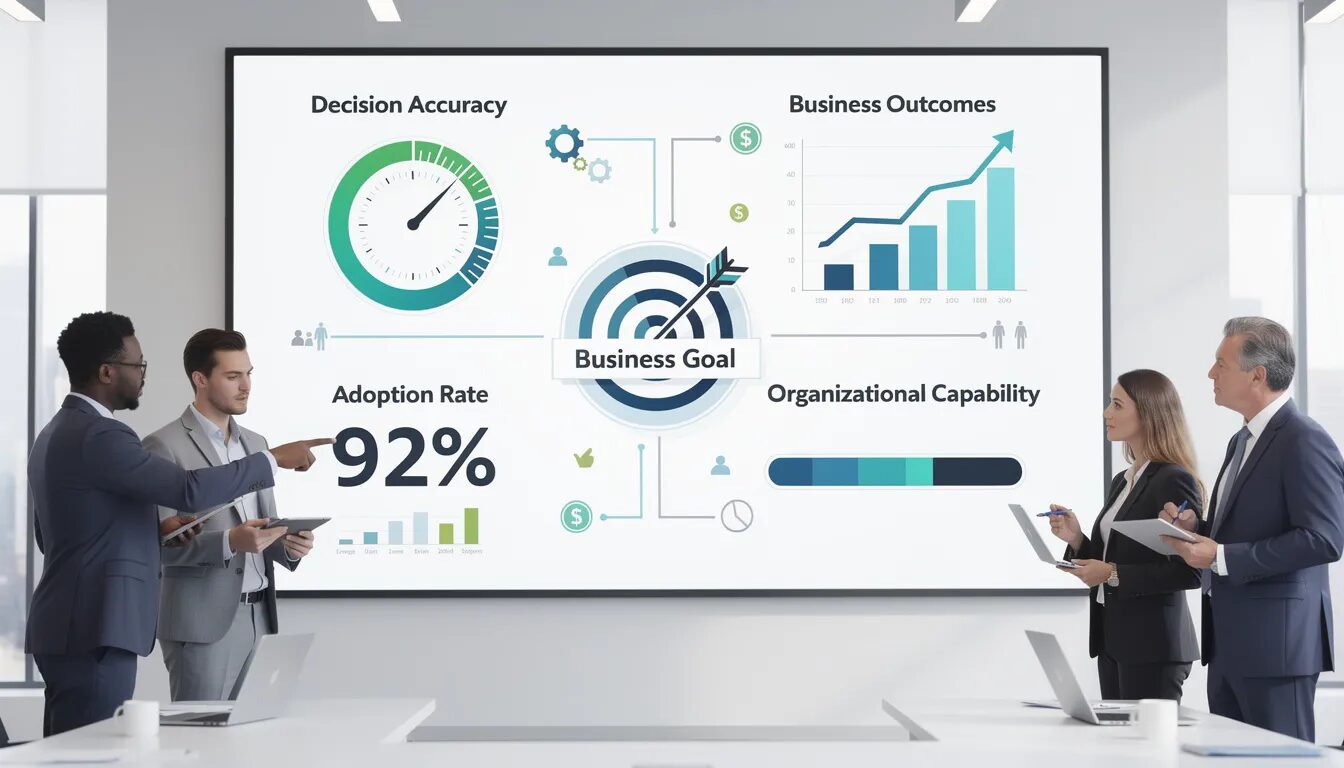
Measuring the success and impact of data driven decision making initiatives requires comprehensive metrics that evaluate both the quality of analytical processes and their business impact. Organizations must track multiple dimensions of performance including decision accuracy, business outcomes, adoption rates, and organizational capabilities to ensure that data driven transformation delivers expected value.
Track decision accuracy improvement rates by comparing data driven decisions to intuition-based choices across similar decision scenarios and time periods. This comparison provides direct evidence of analytical value while identifying specific areas where data driven approaches provide the greatest benefit. Decision accuracy tracking should consider both immediate outcomes and longer-term results to capture the full impact of analytical decision making.
Measure business impact through revenue growth, cost reduction, efficiency gains, and customer satisfaction improvements that can be attributed to data driven decisions and initiatives. Business impact metrics should link analytical initiatives to specific financial and operational outcomes while controlling for external factors that might influence results. This measurement demonstrates the return on investment for data driven transformation efforts.
Monitor data adoption rates across different business units, management levels, and decision types to assess the organization’s progress toward becoming truly data driven. Adoption metrics might include the percentage of decisions supported by analytical insights, frequency of analytics tool usage, and participation in data literacy training programs. High adoption rates indicate successful cultural transformation and organizational capability building.
Assess time-to-insight metrics that measure how quickly data can be transformed into actionable business decisions, from initial data collection through final implementation. Faster time-to-insight enables more responsive decision making and competitive advantage while indicating the efficiency of analytical processes. These metrics should track the entire analytical workflow including data preparation, analysis, communication, and decision implementation phases.
Calculate return on investment for data infrastructure, analytics tools, and talent investments by comparing the costs of analytical capabilities to the measurable business benefits they generate. ROI calculations should consider both direct costs such as software licensing and personnel expenses as well as indirect costs including training and change management. Comprehensive ROI analysis helps justify continued investment while identifying the most valuable analytical applications.
Evaluate employee satisfaction and confidence levels in data driven decision making processes through surveys, feedback sessions, and behavioral assessments. Employee satisfaction with analytical tools and processes indicates successful implementation while confidence in data driven decisions suggests effective training and change management. High satisfaction and confidence levels support sustained adoption and continued improvement of analytical capabilities.
Benchmark analytical maturity against industry standards and best practices to identify areas for continued improvement and investment. Maturity assessments should evaluate multiple dimensions including data quality, analytical capabilities, organizational structure, and cultural factors that influence data driven decision making effectiveness. Regular maturity assessments provide roadmaps for continued development and help maintain competitive positioning.
Track the velocity of analytical innovation within the organization by measuring the rate at which new analytical applications are developed, tested, and implemented across different business areas. Innovation velocity indicates the organization’s ability to leverage data driven approaches for competitive advantage while adapting to changing business conditions. High innovation rates suggest strong analytical capabilities and cultural support for data driven experimentation.
Conclusion
Data driven decision making has evolved from a competitive advantage to a business necessity for modern companies operating in today’s complex, fast-moving marketplace. The organizations that will thrive in the coming decade are those that successfully transform their decision-making processes to leverage data analytics, machine learning, and real-time insights across all aspects of their operations.
The comprehensive framework outlined in this guide provides a roadmap for implementing data driven decision making that addresses the technical, organizational, and cultural dimensions of this transformation. From establishing clear business objectives and building robust data infrastructure to developing analytical capabilities and fostering data driven culture, each component contributes to creating sustainable competitive advantages through better decisions.
The benefits of data driven decision making—enhanced operational efficiency, superior customer experiences, competitive market intelligence, effective risk management, and strategic growth opportunities—are being realized by companies across all industries. The specific applications and technologies may vary by sector, but the fundamental principles of collecting relevant data, applying appropriate analytical methods, and acting on valuable insights remain consistent.
Success in data driven decision making requires more than just technology investments. Organizations must develop data literacy throughout their workforce, establish governance frameworks that ensure data quality and security, and create cultural environments that value analytical thinking and evidence-based decision making. Companies can implement DDDM strategies through technology investment, data governance, and comprehensive employee training, ensuring that all levels of the organization are equipped to leverage data effectively. The companies that excel in these areas will be positioned to capitalize on emerging opportunities while effectively managing risks and uncertainties.
The journey toward becoming a truly data driven organization is ongoing, requiring continuous investment in technology, talent, and capabilities as business conditions and analytical possibilities evolve. However, the organizations that begin this transformation today and commit to building comprehensive data driven decision making capabilities will be best positioned to succeed in an increasingly competitive and data-rich business environment.
The question is not whether your company should embrace data driven decision making—it’s how quickly you can implement the frameworks, technologies, and cultural changes needed to unlock the transformative power of data analytics for sustainable business success.
What is Data Analysis
Data analysis is the systematic process of examining raw data to uncover meaningful patterns, trends, and relationships that can drive business success. In the context of data driven decision making, data analysis transforms vast amounts of unstructured and structured data into actionable insights that inform business decisions and strategies. This process involves a range of techniques, including statistical analysis, data visualization, and machine learning, each designed to extract valuable information from relevant data sources.
Effective data analysis begins with collecting high-quality, relevant data that aligns with organizational goals. Analysts then apply appropriate analytical methods to interpret this data, using tools such as dashboards, charts, and predictive models to visualize results and identify trends. By analyzing data, companies can optimize business processes, improve operational efficiency, and make informed decisions that are grounded in evidence rather than intuition.
For example, statistical analysis can reveal correlations between customer behavior and sales performance, while machine learning algorithms can predict future demand or detect anomalies in operational data. Data visualization tools help communicate these findings clearly, enabling business leaders to quickly grasp complex insights and act on them.
Ultimately, data analysis is a cornerstone of driven decision making, empowering organizations to draw accurate conclusions, optimize business processes, and maintain a competitive edge in a rapidly evolving marketplace. By investing in robust data analysis capabilities, companies can ensure that every data driven decision is supported by reliable, actionable insights.
The Role of Data in Business Decisions
Data is the foundation of effective business decisions in today’s fast-paced, data-driven environment. By harnessing relevant data, organizations can transform their decision making process from one based on intuition to one grounded in objective, factual analysis. Data driven decision making empowers business leaders to reduce uncertainty, minimize risks, and seize new opportunities by leveraging data analysis to extract valuable insights.
Throughout the decision making process, data provides a clear lens into customer preferences, market trends, and operational efficiency. By analyzing data from various sources—such as customer feedback, sales transactions, and supply chain metrics—companies can identify trends that inform business decisions and drive strategic growth. For instance, leveraging data in inventory management enables businesses to optimize stock levels, reduce costs, and improve customer satisfaction.
Business intelligence tools play a crucial role in this transformation, enabling organizations to visualize and interpret complex data sets quickly. These tools help business leaders make informed decisions by presenting actionable insights in an accessible format, supporting both day-to-day operations and long-term business strategy.
Implementing data driven strategies allows companies to gain a competitive advantage, as they can respond more rapidly to market dynamics and customer needs. By continuously harnessing data and integrating it into business processes, organizations can ensure that every driven decision is aligned with their objectives and supported by evidence. In this way, data not only informs business decisions but also drives innovation, operational efficiency, and sustained business success.